
Do i need a will to plan my estate?

Do i need a will?

Benjamin Franklin once said nothing in life is certain but only two things are: death and taxes.

In the unlikely event of your death, have you made sufficient planning so that your last wish could be fulfilled? Dying without a will, also known as intestacy, could give your family and loved ones a hard and frustrating time to sort out what you left behind. (I hope you left assets and not debts) Therefore it is crucial to make sure that you have done your estate planning when you are still around and have a sound mind.

In a survey done few years ago, 8 out of 10 Singaporeans do not have a will. This also means that the heirs belonging to this group of the population could face delay and roadblocks in getting a grant of probate from the Court.

If you do not have a will, your assets will be distributed according to the Intestate Succession Act.

The question now is whether you need a will drafted since there is law in place to distribute your assets?

You can answer this by following the checklist below:

1. First, understand the intestacy rules of distribution

There are 9 rules listed in the Intestate Succession Act (Chapter 146). The rules are distributed according to their order.

Rule Situation Distribution of Assets
1 You left behind surviving spouse with no issue (children) and parent Spouse get 100%
2 You left behind surviving spouse with children Spouse get 50%
3 You left behind surviving spouse with children Children get 50%
4 You left behind surviving spouse and parents Spouse get 50%, Parents get 50%
5 You left behind no spouse and children Parents get 100%
6 You left behind no spouse, children and parents Siblings get 100%
7 You left behind no spouse, children, parents and siblings Grandparents get 100%
8 You left behind no spouse, children, parents, siblings and grandparents Uncles and aunts get 100%
9 You left behind without any next-of-kin, Government get 100%

2. Ask yourself if you are agreeable to the intestacy law

After going through the list, now you need to decide if the law concur with your wish? There are people who may want to will more or less of their assets to an individual and that is when you don’t have a will, it gets tricky. For example, you may wish to distribute part of your asset to your incapacited sibling but without a will, the intestacy rules may fail to adequately provide for your needy dependant.

3. Do you have someone or an organisation in mind?

You may want to provide for your children from your previous marriage, a good friend or a charity. Without a will drafted, these group of people whom you care about will not be getting anything after you leave this world.

4. Do you have a complex and complicated family?

With the growing complexity of family structure, family relationship can get ugly over the tussle of inheritance. This can be problematic when you do not state your wish in a will. The dispute of the will and probate will likely cause stress and feud amongst your family members. Not to mention, the court and legal fees associated that could easily takes up to 5%-10% of your estate.

5. Do you have any minor children?

What happen to your children should there be no surviving spouse? The law requires the appointment of a guardian or trustee until your child reaches the legal age of 21. This person must be someone you trust to ensure your child’s financial is well taken care of. A will allows more flexibility in the appointment of the right person.

You don’t need a lawyer to draft a will and you can actually pen the will yourself. However, to proceed with caution as small mistakes could end up costing your beneficiary more in the future.


Read More...

How to invest in STI ETF?

How to invest in STI ETF?

The Straits Time Index (STI) is a market-weighted index that tracks the top 30 stocks in Singapore. It comprises of some of the large and well established companies in Singapore such as Singtel, DBS, UOB, and OCBC. As such, it is a general indicator of the performance of the Singapore stock market. Think of it as a basket of 30 eggs.

The STI ETF is designed to track the index and replicate the performance of the STI. There are two different fund managers managing the STI ETF, namely SPDR STI ETF (managed by State Street Global Advisors) and the Nikko AM Singapore STI ETF. Both let you trade the STI at a fraction of the cost than owning each stocks individually.

Besides the similarity of both funds tracking the STI ETF listed on SGX, there are a few differences.

SPDR STI ETF (ES3.SI) Nikko AM STI ETF (G3B.SI)
Managed by State Street Global Advisors Nikko Asset Management
Inception date 11 April 2002 24 February 2009
Expense Ratio 0.3% of NAV 0.39% of NAV
Lot Size 1000* (100 in January 2015) 100
Fund Size SGD 425.95M SGD111.14M
Tracking Error 0.07% (1y) 0.27% (3y)
Dividend Yield 2.63% 2.68%

What does these differences tell you? If you are looking to invest for a longer term, go for SPDR STI ETF as it has a lower expense ratio than Nikko AM. However, currently it is sold in lot of 1000 and could be out of reach for some. You can purchase in lot of 100 from Nikko AM, though you can buy the same from SPDR ETF in 2015.

There are different ways which you can invest in STI ETF. Let’s look at the popular ones.

OCBC BCIP POSB Invest-Saver POEMS SBP DIY using SCB
Underlying ETF Nikko AM STI ETF Nikko AM STI ETF SPDR STI ETF Both
Fees 0.3% or $5 (whichever is higher) 1% For amount less than $1,000, $6. Otherwise 0.2%/$10 (Whichever is higher) No Min Commission, 0.2%
Buying Automatic Automatic Automatic Manual
Selling Odd lot Full redemption Odd lot Odd lot
Divindend Reinvestment No No Yes No

From the table, you can see that SCB has the lowest fees, albeit having to dollar cost average manually.

If you are those who don’t have the discipline to do it manually every month, OCBC seems like a good alternative if you can set away more than $500 monthly. For amount lesser than $500, POSB Invest Saver will be more cost-efficient. Do note that, however, if you want to sell your holdings, POSB requires you to do a full redemption where you do not have the flexibility to redeem partial like the others.

POEMS Sharebuilder plan, a more costly option, reinvest your dividend automatically as compared to the rest where you have to do it manually.

In short, to decide which is the best option for you:

Step 1: Decide if you are a discipline investor who can regularly buy into the STI ETF manually

If Yes, go for the DIY option under SCB. If not, go to step 2.

Step 2: Decide the amount you can set away monthly

Less than $500: POSB Invest Saver is cheaper
$500-$3,333: OCBC BCIP
More than $3,333: POEMS SBP

Do note that, however, POEMS SBP has other charges such as a 1% net dividend charge subject to min $1 capped at $50.

Make your own decision and decide which is the best plan for you to invest in STI ETF!

Read More...

How To Pay Zero Income Tax, Legally?

How to pay zero income tax, legally?

When the year is coming to a close, the taxman dress up as Santa Claus and comes knocking on your door. If you have earned at least $22,000 in a year, you will receive a notification from IRAS to file your tax return between February and March.

Nobody like to pay tax. Let’s admit it.

Fortunately, there is a way to not pay it or reduce the total tax liability payable. No and this guide is not going to teach you how to evade tax which is illegal in Singapore.

First thing first, before you learn the various ways on how to reduce your income tax, you need to know how the taxman calculate your taxable income.

There is a nifty calculator in Excel on IRAS website that you can download. There is also an iPhone App call IRAS SG that you can use to calculate your income tax payable.

In short, your chargeable income is calculated as (Employment Income – Employment Expenses) + (Other Income) – (Approved Donations) – (Personal Reliefs). If you are a parent, you can further reduce the tax by claiming Parenthood Tax Rebate (PTR).

From the equation, it is obvious that besides being poor, there are three things you can work on – approved donations, personal reliefs and rebates to reduce or eliminate your income tax payable.

1. Approved Donations

If you are not aware, you can claim 2.5 times the donated amount. For example, if you have made donation of $10,000 to an approved Institutions of Public Character (IPC). Your tax deduction would be $25,000. You can check if an organisation is an IPC here.

Things that you can donate are cash, shares, computer peripherals, artefacts, public art, land and building.

2. Personal Reliefs

There are many reliefs which you can claim to reduce your income tax payable. Let’s take a look at the various reliefs.

a. Earned Income Relief

This is basically a relief to recognise individuals who receive income from work. This will be automatically deducted if you are eligible up to a certain cap. You do not need to claim for this.

b. Spouse/handicapped spouse relief

You can claim for this if your spouse is earning less than or equal to $4,000 a year. You can claim $2,000 for spouse relief and $3,500 if your spouse is handicapped. (From YA2015, you can claim $5,500 for handicapped spouse)

c. Qualifying/handicapped child relief (QCR/HCR)

Likewise, if you have kids you can claim $4,000 per child or $5,500 for handicapped child. (From YA2015, you can claim $7,500 for handicapped child)

d. Working mother’s child relief

This relief is to encourage women to remain in the workforce after having children. The amount you can claim ranges from 15-25% depending on the number and order of children. Please note that there is a cap of $50,000 per child, which includes QCR/HCR.

e. Parent/handicapped parent relief

This relief is to promote filial piety and you can claim for this if the dependant shared the same roof as you. If the dependant is staying in a different household, you must have incurred at least $2,000 in supporting him/her to be eligible for a claim.

If dependant is staying in your household, you can claim up to $7,000 per dependant (or $11,000 for handicapped parents). If dependant is not staying in your household, you can claim up to $4,500 per dependant (or $8,000 for handicapped)

f. Grandparent caregiver relief

This relief is for mother who are working and have engaged their parents/grandparents or in-laws to look after the children. The amount claimable is $3,000 on one parents/grandparents/in-laws.

g. Handicapped brother/sister relief

If your siblings are handicapped and you are supporting them, you can eligible to claim $3,500 for each sibling. (From YA2015, you can claim up to $5,500) Note: If your parents have claimed HCR on your brother/sister, you cannot claim for this relief.

h. CPF Relief

CPF relief is given to encourage individuals to save for their retirement. You can claim on your compulsory employee CPF contribution and any voluntary contributions to your Medisave account. If your employer is in the Auto-Inclusion Scheme then this will be automatically calculated. If not, you will need to claim this yourself. Please note that you can only claim if your employee CPF contributions has not exceeded the Ordinary and Additional Wage Ceiling. OW is currently $5,000 a month. Additional wage refers to annual bonus and leave pay and the formula used to computer AW ceiling for 1 Jan 12 – 31 Dec 13 is $85,000 minus total OW. AW is subject to a cap of $37,000.

For more details on the calculation, refer to IRAS website.

i. Life Insurance Relief

You can claim for this if you have bought insurance for yourself and your wife. If you are a married female and satisfy the various conditions, you can only claim for your own life policies and not your husband’s. The amount claimable is the lower of $5,000 less your CPF Contrition or up to 7% of the insured value. Note: If you contributes more than $5,000 for CPF, you are not eligible for this.

j. Course Fee Relief

The government wants the workforce to be equipped with the necessary skills and encourages individuals to constantly upgrade themselves through course so as to enhance employability. You can claim up to a maximum of $5,500 per year.

k. Foreign Maid Levy Relief

Foreign Maid Levy (FML) relief is given to encourage married women to continue to be in the workforce. Thus, if your household has employed a maid, you are eligible for this levy. You can claim twice the amount of levy on one domestic worker paid in the previous year.

l. CPF Cash Top Up relief

This relief is to encourage individuals to top up their Retirement or Special Account under the CPF Minimum Sum Topping Up Scheme. You are also entitled to the relief if your employer made the top-up for you. You can claim up to a cap of $7,000 for self and an additional $7,000 if you top up the account of your spouse, siblings, parents, grandparents and your in-laws.

m. Supplementary Retirement Scheme (SRS) Relief

If you have contributed to SRS, you can claim the amount up to the maximum cap of SRS contribution of $12,750 if you are a Singaporean/PR or $29,750 if you are a foreigner.

n. NSman (Self/Wife/Parent) Relief

For the guys, here’s another bonus for you if you have completed your national service. The general population can claim up to $3,000 if you have performed NS activities in the preceding years or $1,500 if you haven’t. For key appointment holders, you can claim up to $3,500 and $5,000 respectively.

For the ladies and parents of Neman, you can claim a deduction for $750 for the support you have given to your husband/son.

3. Parenthood Tax Rebate (PTR)

Lastly, you can claim a rebate from your tax payable if you qualify for PTR. This should be differentiated from tax relief which reduce your chargeable income. It is offered to married Singapore tax residents as an incentive to encourage them to have more children. You can claim up to $5,000 for the 1st child, $10,000 for the second and $20,000 for the 3rd and beyond. This amount can be shared between you and your spouse to offset the tax payable.

Read More...

Should i buy term or life insurance?

Should i buy term or life insurance?

Congratulations. You have just tied the knot, moved into your new house and plan to start your own family. What’s next?

You have also acquired the debts and liabilities of having a mortgage to service and a family to feed.

Now the most important question daunt you. What happens if an unfortunate event renders you and/or your spouse incapacitated? Imagine a pillar that gave way and cause the entire building to collapse. It will be a disaster for that to happen.

How do you address that then?

You need another pillar to support the building. Insurance is the key – the third pillar. Getting yourself covered is the most responsible thing you can do for the family.

What are the different type of insurance?

There are many types of insurance in the market and knowing which is the most appropriate for you is an important financial decision. There are two main types of life insurance.

1. Term Insurance
2. Whole Life Insurance

Term insurance, as the name suggests, covers you for a term period you define. It can be as short as a yearly renewable term or it can cover you all the way until you become a centenarian.

Whole life insurance covers you for the entire life. The key difference is there is no cash value for a term plan as compared to whole life insurance.

The question now boils down to if you should get term or whole life insurance or a combination of both?

Term versus whole life insurance

Whole life insurance might seem attractive with a guaranteed cash value being paid out should you decide to surrender the policy later in the policy years. It seems like a no-brainer then – to get whole life insurance rather than a term policy that expires with no cash value. At least, that’s what many financial planners out there are advocating. Why pay to rent a house (in this case, purchasing term insurance) when you can afford to pay for the house and own it (purchasing whole life insurance)?

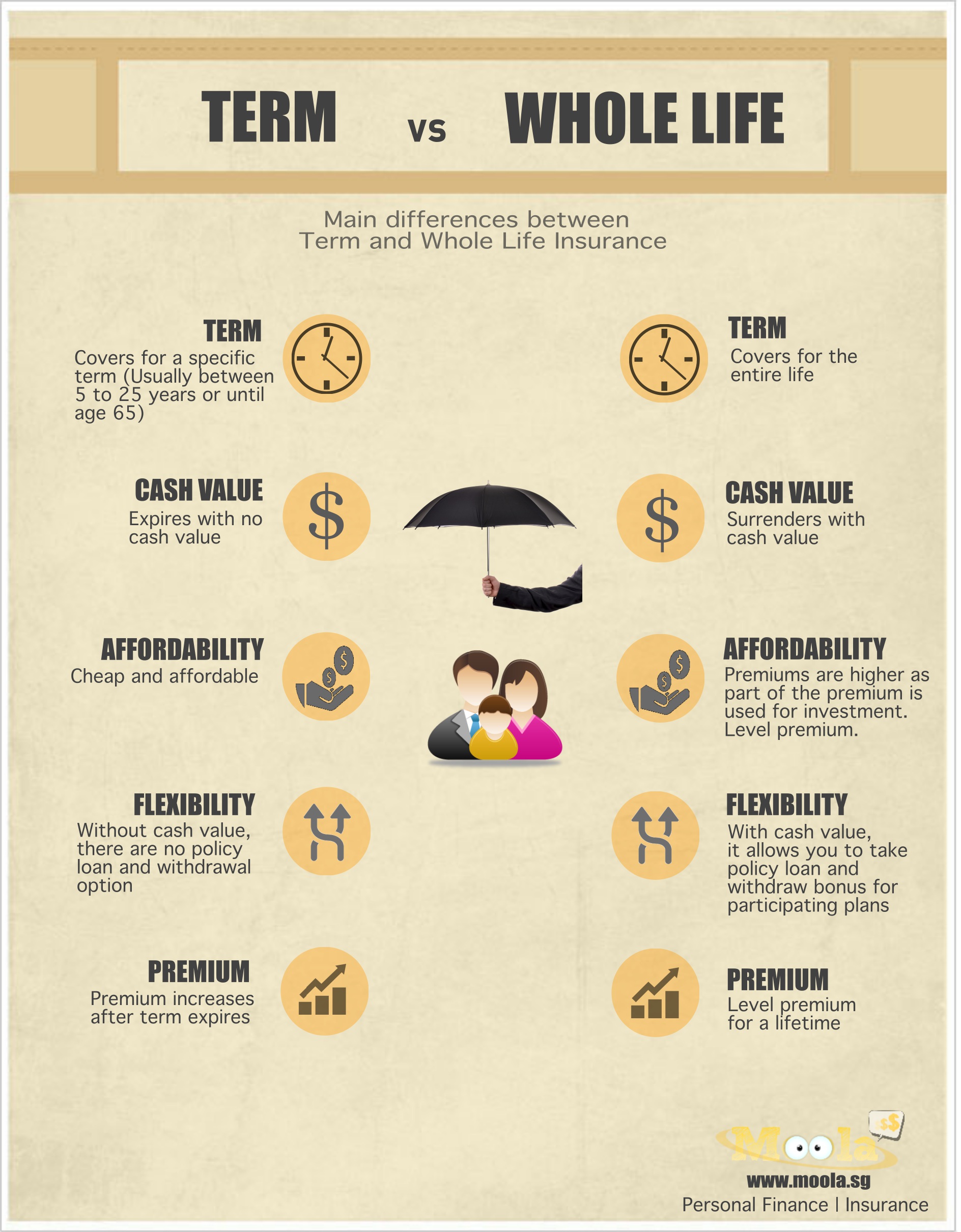
First, here’s a nifty infographic that put them side by side to show you the main differences.

Term vs Whole Life Insurance

Now after understanding how both products work, let’s place both of them side by side and examine them.

Let’s assume the following scenario:

Paul, a 25 years old male who wishes to get covered at $100,000 sum assured for death, terminal illness and disability. He also wants to accumulate some cash for retirement.

There are two options he can consider:

1) Buy a whole life insurance that can meet both needs; or
2) Buy a term insurance and invest the difference in other assets

1) Buying a Whole Life Insurance

It will costs him $112/month to get a $100,000 cover for death, terminal illnesses and disability. Should he retires at 55 years old (30 years later), he can choose to surrender the policy with a guaranteed cash value of $28,646 together with a non-guaranteed portion of $30,142 (using a bonus rate of 4.75%) – having paid $40,170 in premiums altogether.

Not too bad isn’t it? Even if the economy has taken a beating and Paul doesn’t get the guaranteed portion of $30,142, he still gets back $28,646. Then the outlay for his protection would cost him $11,524 over 30 years. Well, no free lunch in this world, so the question is if it is justifiable for him to pay that amount for insurance?

a) Yes, it is reasonable to pay $11,524 for protection over 30years. Furthermore, it only costs him around $384/year.

b) Some may also argue that there is still a possibility of him getting some of the non-guaranteed portion and even have the chance to make a ‘profit’ of $18,618.

Wait..

Let’s take a look at the second option and see how it matches up.

2) Buying Term Insurance and investing the difference

A similar term cover for Paul would cost him $12.80/month under the SAF Group Term Life insurance. That adds up to $153.60/year. It covers Paul for 30 years and it expires without cash value when he is 55.

The difference of $99.20 as compared to the first option can be invested into other assets such as STI ETF which has return 7-8% for the past 30years.

Assuming a 8% growth, Paul would have accumulated approximately $147,843.66 when he is 55 years old. Now contrast that with the first option of a guaranteed $28,646 plus a non-guaranteed of $30,142. The difference is huge.

Even if Paul is more conservative and expect a growth of 4%, he should be expecting a cash value of $68,849.90 after 30 years.

Wait, isn’t it non-guaranteed as the first option? But hey, Paul has the full control and flexibilities on when he can liquidate his invested assets should rainy days come.

We have our winner: Buying term insurance and investing the difference is the way to go!

And if you are still not convinced, Suze Orman says it all.

Read More...