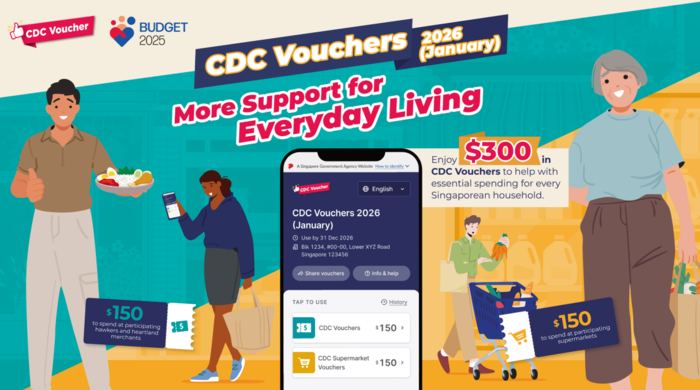
Starting 2 January 2026, every Singaporean household can claim S$300 worth of Community Development Council (CDC) vouchers — the latest support designed to help you with everyday expenses and support heartland businesses across the island.
These vouchers are part of the Government’s ongoing effort to cushion rising costs of living and give families and individuals a hand where it matters most. They follow on from the S$500 CDC vouchers disbursed in May 2025, bringing the total support for this financial year to S$800 per household.
How It Works
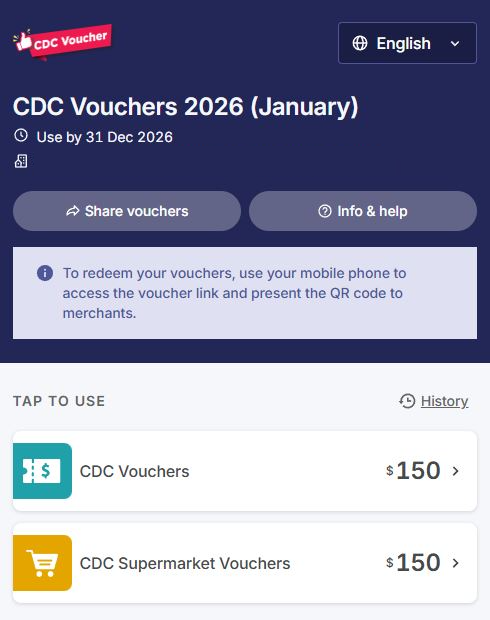
It’s simple and convenient — claim your vouchers online via go.gov.sg/cdcv using your Singpass, and they’ll be ready to use digitally. There’s no need to download any separate app — making it easy even for first-time users.
Once claimed, the S$300 CDC vouchers are valid until 31 December 2026, so you have plenty of time to spend them on essentials.
Where You Can Spend
Make every dollar count — the vouchers can be used at:
$150 CDC Vouchers 2026 (January) to spend at participating heartland merchants and hawkers — enjoy your favourite laksa, nasi lemak, kopi and more.
$150 CDC Vouchers 2026 (January) to spend at participating supermarkets — ease grocery costs for your household.
With daily costs like meals and groceries taking up a big chunk of monthly spending, this latest tranche of CDC vouchers offers practical relief that goes straight where you need it — in your trolley, on your hawker tray, and around your neighbourhood. It’s support that’s easy to use and feels immediate.
Explore why international schools value play-based learning to support confidence, creativity, and balanced development in early education.
Why International Schools Choose Play-Based Learning in Early Childhood Education
International schools seek approaches that respect childhood curiosity while building academic readiness through meaningful experiences. Play-based learning meets that aim through thoughtful classroom practices that feel natural rather than forced. Educators value this model because it supports emotional confidence, social balance, and steady intellectual progress.
Early childhood education gains depth through guided play that links imagination with purposeful learning experiences. This approach supports curiosity, emotional growth, and cognitive development through meaningful daily interactions. This article explores reasons international institutions favour this model.
Cognitive Growth Through Purposeful Exploration
Play-based frameworks allow mental growth through curiosity-driven exploration rather than rigid instruction. Learners engage concepts through tactile materials, imaginative scenarios, and collaborative challenges within guided spaces. Such environments encourage reasoning, memory development, and flexible thought patterns through meaningful experiences. Educators observe strong problem-solving capacity because children test ideas freely without fear of error.
Language skills advance through dialogue, storytelling, and role-play within shared activities. Mathematical awareness emerges naturally during construction tasks, sorting games, and spatial puzzles. This approach respects developmental pace while promoting intellectual confidence across varied abilities. International schools appreciate this balance because it supports diverse learners within multicultural classrooms.
Social Confidence and Emotional Balance
Healthy peer interaction stands at the centre of play-based classrooms within international settings. Children practice cooperation through shared goals, imaginative narratives, and group problem solving. Emotional literacy grows as learners express feelings during pretend play or collaborative tasks. Teachers guide conflict resolution gently, allowing empathy and patience to develop authentically.
Such experiences strengthen self-regulation without pressure or comparison among peers. Social confidence increases because participation feels inviting rather than evaluative. International communities value this harmony due to varied cultural expectations around expression. Emotional balance supports smoother transitions into later academic stages.
Cultural Inclusion Through Flexible Play Structures
International schools serve families from many regions, languages, and traditions. Play-based learning adapts easily to cultural diversity through open-ended materials and shared storytelling. Children introduce personal experiences into play narratives, enriching classroom perspective. This adaptability creates respectful dialogue among peers from varied backgrounds.
Early childhood education in Singapore highlights cultural sensitivity through inclusive play themes. Educators observe strong identity development because children feel represented within daily activities. Flexible structures allow celebration of traditions without formal lessons. International institutions favour this inclusivity because it nurtures global awareness naturally.
Educator Roles Within Guided Discovery
Teachers act as facilitators rather than lecturers within play-based environments. Observation guides lesson design, ensuring support aligns with individual developmental readiness. Educators pose thoughtful questions that extend thinking without interrupting exploration flow. This guidance encourages independence while maintaining academic intention.
Professional expertise shapes environments that invite inquiry through purposeful material selection. Assessment occurs through observation, documentation, and reflective dialogue rather than formal testing. Such practices respect childhood rhythm while providing meaningful insight. International schools trust this role because it balances freedom with responsibility.
Learning Spaces That Invite Curiosity
Classroom design plays a crucial role in play-centred programs. Spaces feature accessible materials, calm colour palettes, and flexible layouts. Children explore areas independently, supporting autonomy and decision confidence. Learning zones reflect varied interests such as art, construction, reading, and dramatic expression.
Clear pathways promote safe movement while maintaining focus and engagement throughout the day. Thoughtful arrangement supports collaboration without overcrowding or unnecessary distraction. Such environments encourage sustained attention, creativity, and respectful shared use of space.
Thoughtful Material Selection
Resource choices influence engagement quality within play-based classrooms. Materials remain open-ended, durable, and culturally neutral to support varied narratives. Natural elements such as wood, fabric, and recycled objects inspire imagination. Educators rotate items based on observed interest and developmental readiness.
This practice prevents overstimulation while sustaining curiosity. Learners develop respect for shared resources through guided care routines. Such environments promote responsibility without strict rules. International schools appreciate this balance because it supports mindful habits.
Assessment Without Pressure
Evaluation within play-based models relies on observation rather than formal examination. Educators document progress through notes, photographs, and reflective summaries. This approach captures authentic growth across social, cognitive, and emotional domains. Children remain unaware of the assessment, preserving joy and confidence.
Families receive detailed insight into development through narrative reports. Such communication builds trust and transparency between school and home. International communities value this clarity across language differences. Pressure-free evaluation supports long-term motivation.
Preparation for Lifelong Learning
Play-based foundations prepare learners for future academic demands through confidence and curiosity. Children develop resilience through trial, adaptation, and creative problem-solving. Motivation remains intrinsic because discovery feels rewarding rather than compulsory. These qualities support adaptability across varied educational systems worldwide.
International schools seek graduates who think critically and collaborate respectfully. Play-based beginnings nurture these attributes naturally. Learners transition smoothly into structured learning with strong self-belief. This preparation aligns with global education goals.
International schools continue to select play-based models because they honour childhood while building capable, confident learners. This approach aligns emotional well-being, cultural respect, and intellectual growth through thoughtful practice. Play-based learning in early childhood education helps establish strong foundations for curiosity and lifelong learning. This foundation encourages adaptable thinking and strong social awareness, qualities valued across diverse educational communities worldwide.
Ask us questions, discover the latest offers & more on Telegram.
If you’ve been waiting for the right moment to switch mobile plans or top up your balance, this is it. eight is bringing back its 88 Deals this holiday season, and the offers are exactly as shiok as they sound — big value, no nonsense, and seriously limited-time.
Running from 14 to 16 December only, these deals are available at 400 island-wide retailers and online, so you don’t even need to queue long-long to enjoy the perks.
Switch to eight & Get 88 Days FREE
Thinking of porting over? eight is making the switch extra rewarding.
Switch to eight and enjoy 88 days FREE on all mobile plans. (equivalent to 3 months!)
That’s nearly three months of savings, just for making the move. No complicated hoops — just switch, activate, and enjoy.
1-For-1 Top Up: Load $88, Get $88 FREE (Up to 8 times!)
This is where the deal gets even more interesting.
During the promo period, users can enjoy 1-for-1 top ups up to 8 times. That means every time you load $88, you’ll receive another $88 FREE — up to eight separate top-ups.
In simple terms?
If you max it out, you’re effectively getting up to $704 worth of value from this promotion alone.
No complicated mechanics, no lucky draw — just straight-up bonus value credited to your account.
Whether you’re switching plans or topping up, these 88 Deals are designed to be fast, fuss-free, and worth your time. With availability both in-store and online, there’s really no excuse to miss out.
📍 Available at 400 island-wide retailers 🌐 Online via Main Balance > Top up 📅 Only from 14 to 16 December
Don’t blink — once the 3 days are up, these deals are gone.
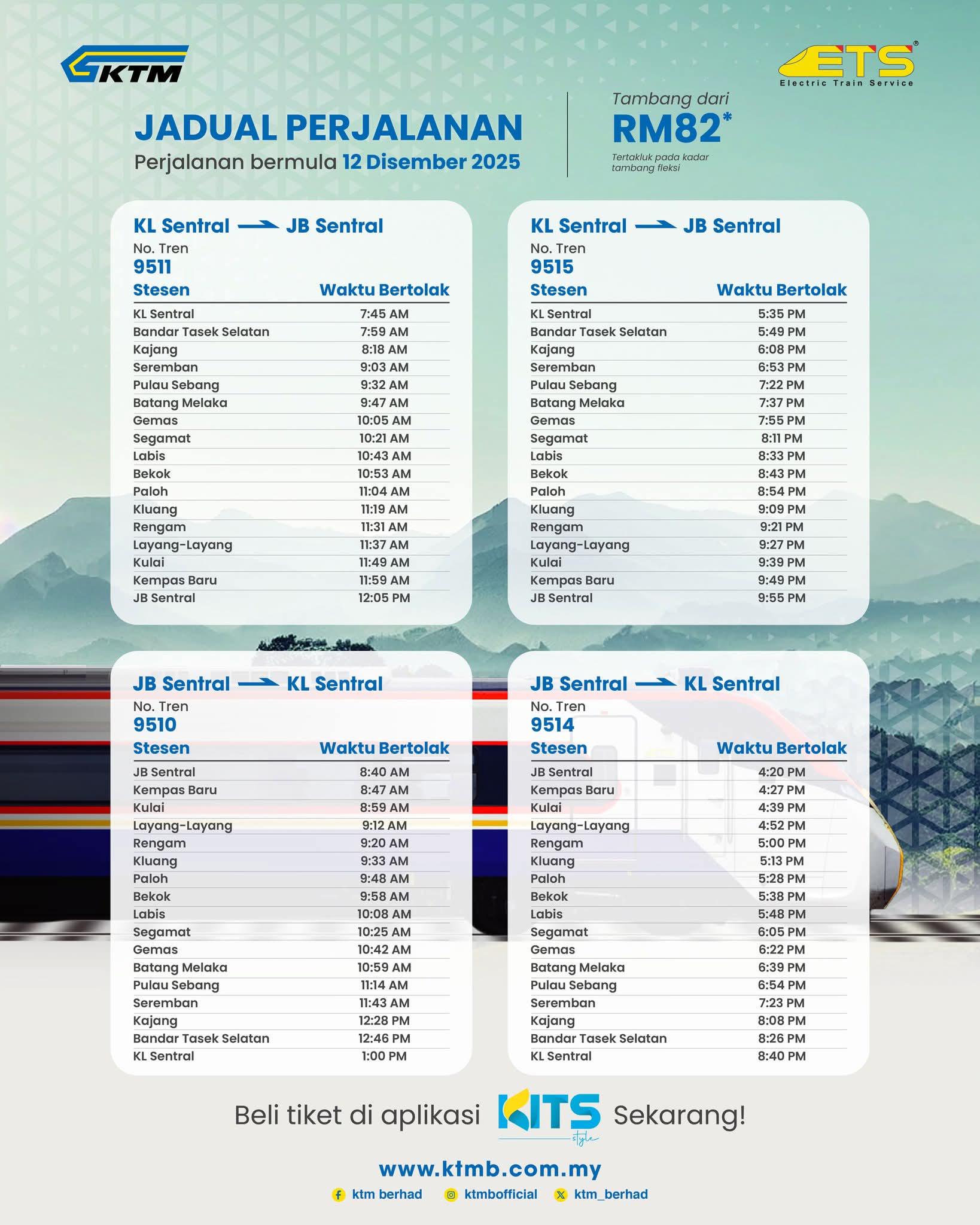
After years of anticipation, Malaysia’s Electric Train Service (ETS) officially extends to Johor Bahru on December 12, 2025. This game-changing development cuts travel time between KL and JB in half and opens exciting new possibilities for Singaporeans exploring Malaysia.
A Faster, More Comfortable Journey
The new ETS route transforms the KL-JB journey dramatically. Where diesel trains currently take seven hours, the ETS3 completes the trip in about 4.5 hours at speeds up to 140 km/h. The train stops at Segamat, Kluang, Kulai, and Kempas Baru before reaching JB Sentral, making previously hard-to-reach Johor towns easily accessible.
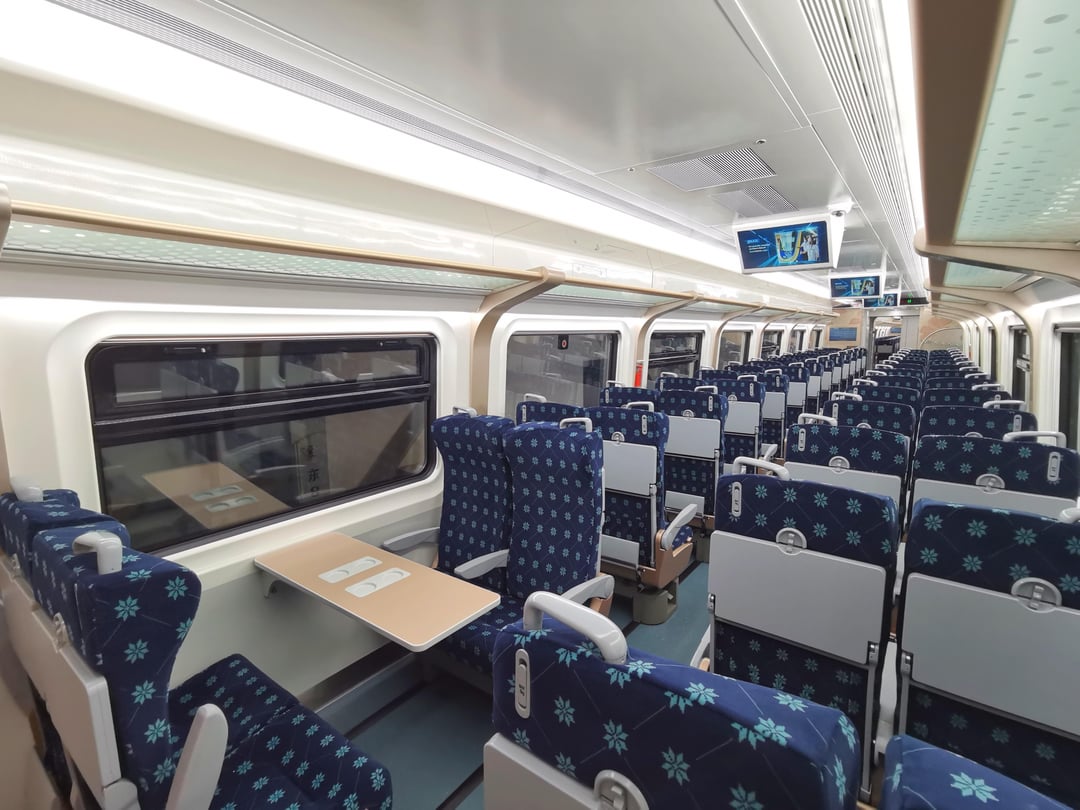
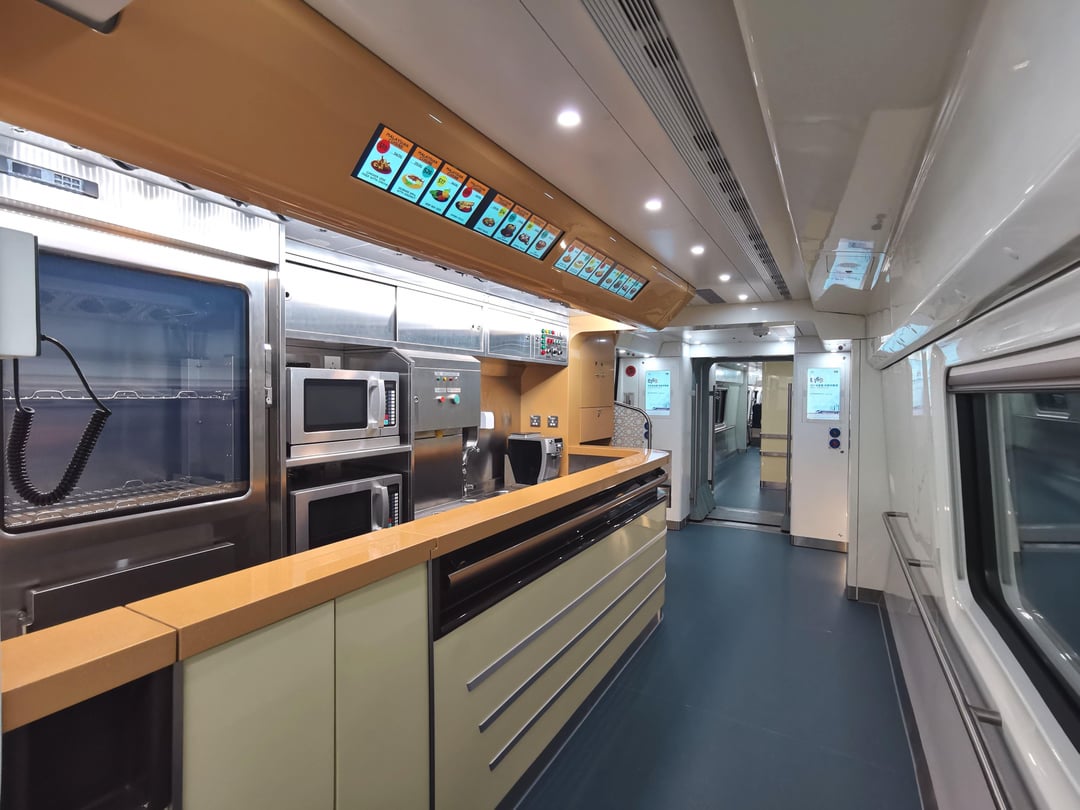
Modern amenities include USB charging ports, clean onboard toilets, and a cafeteria. Each train accommodates 300 to 500 passengers, with multiple daily services planned.
Ticket Prices and How to Book
ETS tickets from JB Sentral to KL Sentral start from RM82, with three service classes available:
ETS Platinum: Premium service with fewest stops and complimentary snacks
ETS Gold: Balanced option with fewer stops than Silver
ETS Silver: Most economical, stopping at all stations
Launch special: 30% discount for tickets purchased December 12 to January 11, 2026, using promo code JBBEST (limited to 5,000 redemptions).
Booking Your Tickets from Singapore
Official KTMB Channels:
KITS Website: Book at online.ktmb.com.my with account registration
KITS Style App: Download for mobile booking
Kiosks and Counters: Available at JB Sentral and other stations
Seamless Connectivity to Singapore
For Singaporeans, the real excitement lies in the enhanced connectivity this service brings. JB Sentral, the terminal station for the ETS, is strategically located and will soon connect to Singapore’s upcoming Rapid Transit System Link (RTS Link). The RTS project, linking Bukit Chagar in Johor Bahru and Woodlands North in Singapore, is scheduled for completion in December 2026 with operations commencing in early 2027.
This integration means Singaporeans will soon be able to travel from Woodlands North MRT via the RTS to JB Sentral, then seamlessly board the ETS to Kuala Lumpur and beyond, all without dealing with traffic congestion at the Causeway. The connection between the two services will feature sheltered walkways, escalators, and lifts for easy transfers.
A New Era of Travel
This ETS extension represents more than improved transportation—it’s a gateway to easier business travel, tourism, and exploring Malaysia without driving stress. For Singaporeans, it means convenient access to Johor’s attractions and the ability to venture deeper into Malaysia with speed and comfort.
As Malaysia completes its West Coast rail electrification, the December 12 launch marks a new chapter in cross-border connectivity, bringing Kuala Lumpur within easy reach and transforming how we explore our northern neighbor.
Ophthalmologist introduces flapless laser vision correction procedure as an alternative to LASIK and SMILE. When Dr Natasha Lim first learned about Smooth Incision Lenticule Keratomileusis (SILK), she saw an opportunity to offer her patients better outcomes with less invasive procedures. Now, as one of Singapore’s pioneer surgeons performing SILK, Dr Lim is ushering in an alternative approach to refractive surgery that may be suitable for a wider range of patients seeking vision correction.
Clinical Background and Professional Experience
Dr Natasha Lim has made significant contributions to the field of refractive surgery throughout her career, being the only ophthalmologist from Singapore whose LASIK results were published on the worldwide AMO iDesign Registry, a platform used by LASIK surgeons for clinical reference.
Her experience with established refractive procedures has thus informed her decision to offer a newly advanced SILK technology to modern laser vision correction (LVC) candidates. Having performed many LASIK procedures, Dr Natasha Lim recognised that SILK’s technological advancements could address certain limitations of existing LVC techniques. Her comprehensive understanding of corneal biomechanics and refractive outcomes positions her to evaluate which patients may benefit from this flapless approach.
Understanding SILK as a Refractive Option
For patients considering laser vision correction, SILK represents a flapless alternative to existing procedures like LASIK.
LASIK, an established refractive surgery for myopia and astigmatism, involves the creation of a corneal flap. The procedure has been performed for several decades with documented outcomes, demonstrating efficacy in correcting myopia up to -12.00DS and astigmatism up to -6.00DC clinically.
SILK, on the other hand, is a flapless procedure and has been shown to address a comparable range of myopia up to -12.00DS and astigmatism up to -6.00DC. The procedure uses a femtosecond laser to create and extract a lens-shaped piece of corneal tissue (called a lenticule) through an incision of approximately two millimetres only. The system uses unique femtosecond laser cutting technology that combines short pulse duration, small laser spot size, and high pulse repetition rate, which enables a continuous, tissue bridge-free laser resection for a smooth corneal surface.
The flapless nature of SILK means the procedure does not create a corneal flap, hence does not suffer certain risks associated with flap complications, such as cornea wrinkles, flap dislocation, corneal ectasia and dry eye syndrome2, all of which can affectboth immediate and long-term visual outcomes.
Technical Development from SMILE
SILK also builds on Small Incision Lenticule Extraction (SMILE), introduced in 2009, incorporating technological modifications to the SMILE technique.
The SILK procedure employs a submicron-precision laser system delivering lower energy per pulse of 40 to 90 nanojoules, designed for minimal collateral tissue damage, hence enabling smooth tissue dissection with the aim of reducing post-operative inflammation.
Compared to the asymmetrical shape used in SMILE, SILK uses a biconvex lenticule shape intended to facilitate smoother tissue extraction and create a more uniform corneal surface. Combined with the reduced laser energy, these technological refinements aim to shorten surgical time and enable faster post-operative visual recovery.
Dr Natasha Lim added: “As an updated version of SMILE, SILK has the potential to be a more effective option for refractive surgery with reduced downtime.” and that “Ophthalmologists may soon advise SILK surgery for patients seeking a more comfortable and quicker path to clear vision.”
The SILK Procedure
The SILK procedure takes approximately two minutes per eye. Before surgery begins, detailed measurements of the patient’s eye—including corneal thickness and prescription strength—are entered into the SILK laser system. The system then automatically calculates the exact specifications needed for the tissue removal.
During the procedure, the patient is positioned comfortably under the surgical microscope and laser system. The patient will be directed to focus on a small light to keep the eye steady while the laser creates a precise cutting pattern in the cornea. The surgeon then carefully removes the lenticule through the small incision.
The laser application itself takes approximately 16 seconds, with 85.3% of eyes requiring only mild dissection.
Clinical studies of SILK demonstrate favourable outcomes for visual recovery, with patients reporting an average of one day of downtime for the cornea to reshape. Within one week, 88% of patients experienced 20/20 vision or better, increasing to 96% within three months.
Patient satisfaction data also shows positive responses: 100% of patients reported satisfaction with having undergone the SILK procedure, while 98% were satisfied with the speed of their vision improvement. Additionally, 96% of patients indicated they would recommend SILK to friends or family members.
Expanding Options for Vision Correction
As a pioneer surgeon for SILK in Singapore, Dr Natasha Lim provides patients with access to this recent development in refractive surgery alongside established procedures such as LASIK, PRK and Implantable Collamer Lens surgery. The availability of multiple laser vision correction technologies at her eye centre in Royal Square Novena allows Dr Lim to unbiasedly recommend treatment options tailored to each patient’s specific ophthalmological conditions and clinical profile.
To learn more about which refractive surgery option may be suitable for your vision correction needs, schedule a consultation with Dr Natasha Lim at Dr Natasha Lim Eye Centre.