Your Ultimate Guide to Planning Your Europe Trip

Ultimate Guide to Planning Your Europe Trip

In our earliest post on How to travel Europe on a shoestring budget, we talk about how you can travel to Europe without breaking the bank. Careful planning is essential and that is what this article is going to focus on.

Step 1: Prepare the things you need

Things you need:
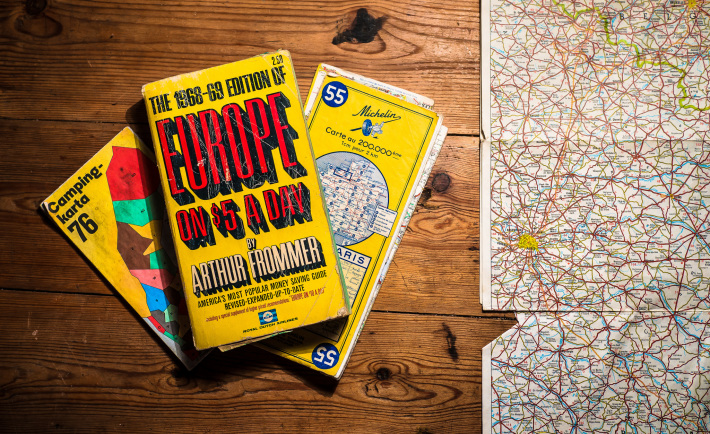
1. Map of Europe (Google map will do fine)
2. Notebook & writing materials
3. Internet and/or travel guides
4. Credit card (For making online booking)
5. Travel Companion(s) (duh, to discuss.)

Step 2: Shortlisting the places in Europe you want to visit

This is going to be the most exciting and fun part of the planning. With occasional squabbles, you will spend hours researching on the best places to go with your travel companion.

Go do some research on the most travelled places and UNESCO’s world heritage sites. Use a travel guide to do your research if you have one. Otherwise, just connect to the internet and use Google.

Jot down the places you want to go in this order.
[Places of attraction] – [City], [Country]

For example,
1. Eiffel Tower – Paris, France
2. Colosseum – Rome, Italy
3. (List goes on, depending on how adventurous you are)

Mark a cross ‘X’ on the map for each destination. (I hope you don’t fill the entire map with crosses.)

Step 3: Plan your travel route

Now that you have shortlisted the places you want to go, it’s time to plan your travel route in the most efficient manner. By efficient, i mean the route that saves you the most time and resources.

Before you jump into planning the route, go search for the cheapest airfare to any of the European city that you have shortlisted first. This will be the first and your last stop of your travel plan.

There are online aggregators that compare the cheapest flight for you. For example, there are sites like SkyScanner, FareCompare, Kayak, Expedia and Zuji where you can enter your departure and return date and you get a list of flights where you can sort and filter the prices accordingly. Try to search for the cheapest return airfare. For some, there are also other factors to consider such as the quality and service of the airlines, convenience of the airport, miles point, etc. I will leave the prioritisation to you.

Once you have confirm the city to be the first and last stop. Label the cross ‘X’ with 1. I will use Amsterdam, Netherlands as an example.

Next, look for the next ‘X’ that is bordering around Amsterdam, Netherlands. By bordering, i mean connected that is not separated by land or sea. In my example, my next stop will be to visit Kölner Dom in Cologne, Germany. Mark it as 2, and follow on with the rest.

My third stop will be Museumsinsel (Museum Island) in Berlin, Germany

The rest as follows:

  • 4th stop: Prague (Czech Republic)
  • 5-6th stop: Vienna -> Salzburg (Austria)
  • 7-11th stop: Venice -> Rome -> Florence -> Pisa -> Milan (Italy)
  • 12-14th stop: Lauterbrunnen/Junfraujoch -> Zurich -> Basel (Switzerland)
  • 15th stop: Paris (France)
  • 16th stop: London (UK)(There is a train operated by Eurostar that takes you from Paris to London)
  • 17th stop: Amsterdam (Netherlands) (You can take budget airline such as Ryanair or a Ferry from London to Amsterdam)

*Note: Such itinerary took me a month to travel to all the places. It was tiring but fun and satisfying to conquer all of them within one month. If you were to ask me again, i would suggest condensing the above itinerary to 10stops/4 countries tops if you can only afford anything less than one month of travel. If you can afford to be away longer, go for it!

Step 4: Get busy with the nitty gritty

Now that you have a map filled with ‘X’s and numbers. You need to work out your mode of transportation that takes you from each stop.

Europe is connected by high-speed rails and you can easily hop around country in a matter of hours.
You can purchase the Eurail Global Pass that allows you to take their high speed train.

If you are age 25 and below, good news for you! You can get the Youth Traveller Pass. It costs about €442 for a 10days travel within 2 months. Check out the latest price at their website. You can also purchase them from our local travel agency. Just call them and ask.

It is not cheap, but it beats taking a more costlier option – budget airlines. Taking rail also save you times if you travel at night and book one of their sleeper cabin.

Now you need to schedule your train’s timetable time. Eurail has a very useful timetable that allows you to check out the train arrival and departure time.

For example, a route from Amsterdam, Netherlands to Cologne, Germany.
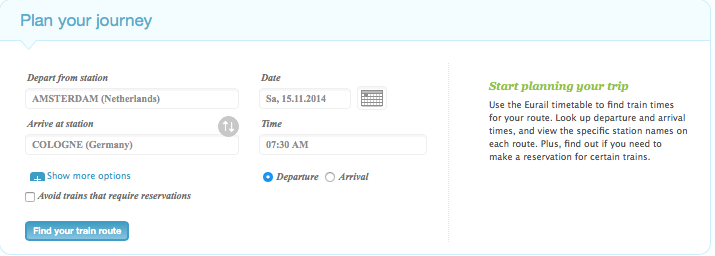
Amsterdam-to-Cologne

There are a few routes with different timing and train. Some of the route requires you to change train. Make sure you pick the right one.
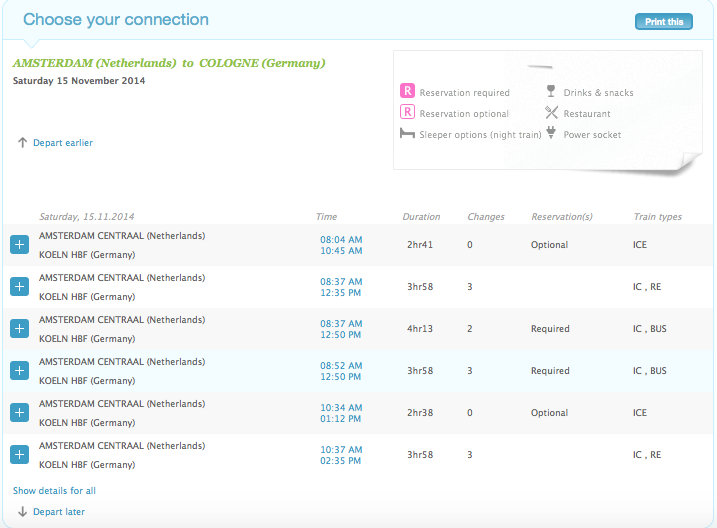
Amsterdam-to-Cologne-trains

Note down the details of the train station and arrival timing in your notebook. You will need them later.

Step 5: Book your accommodation

Once you are done with planning for your train timing, you need to settle your accommodation. Look for
an accommodation that is situated near your railway station (if you are reaching at night) or a somewhere near the places of attraction.

There are different kind of affordable accommodation which you can consider instead of booking a hotel.
1. Backpackers/Hostels (Use Google)
2. Homestay (I’d suggest airbnb)
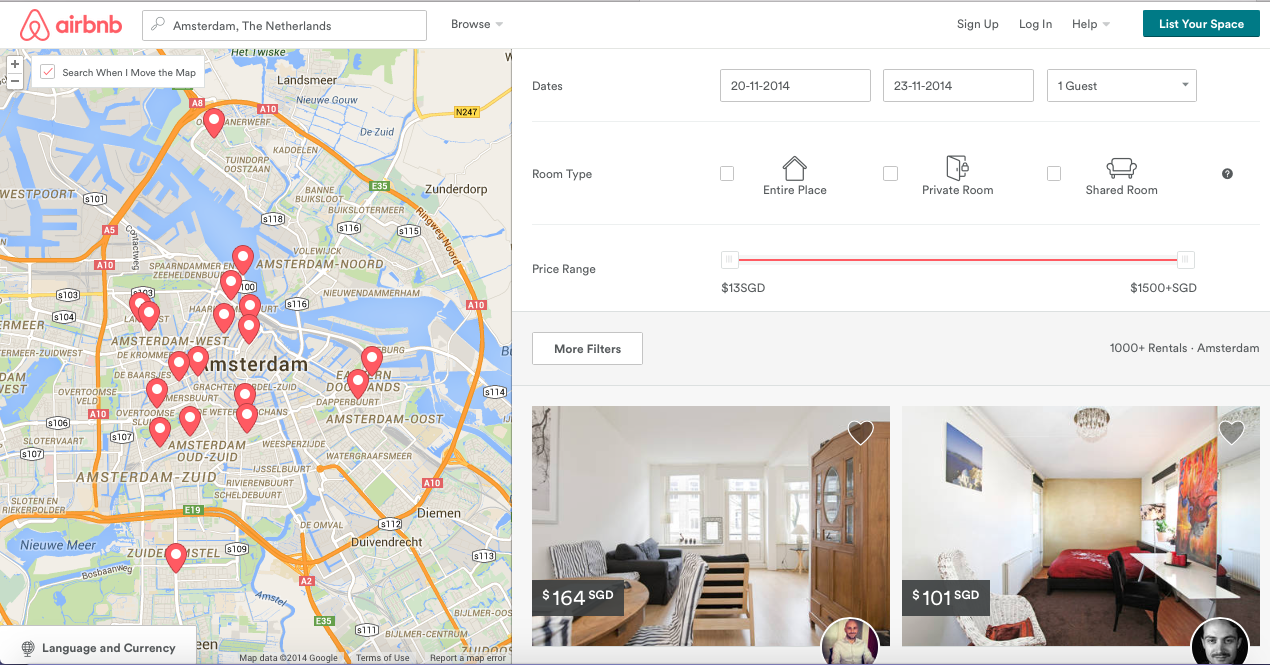
airbnb
3. Couchsurfing (free)

Couchsurfing

You will need your credit card to make the booking.

Step 6: Prepare and print the confirmations

Your last step would be to print out all the booking confirmation, fix them onto your notebook or file. I stapled all the confirmations and maps on each pages of my notebook from day 1 to day 30 so that it won’t drop. I also download offline maps of each cities on my iPad.

Now you can skip the travel agent and save the cost on tour packages!

Here’s the final product on a map.
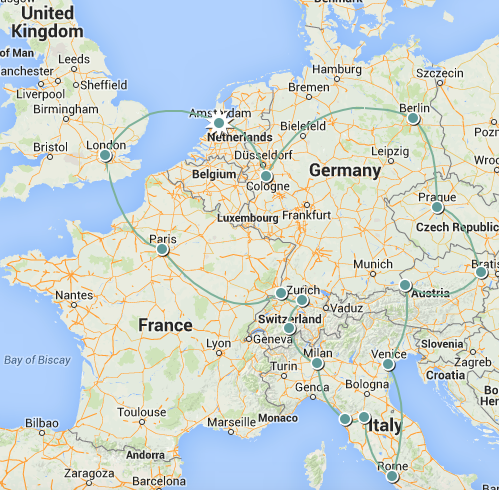
Map-Route

Read More...

Drivers, 12 Fuel Saving Tips You Need to Know

Drivers, 12 Tips to save on your fuel

If you have been driving for the past couple of decades, you would have noticed that fuel price has increased by 100% since 1991. It used to cost around a dollar for a litre of 95 Octane and now it has creep to $2.20 a litre in 2014. With increasing population, expect the road to be more congested and that’s when you see more ERP gantries, astronomical COE price and increased excise duty on fuel.

Here are 12 fuel saving tips tips to help you save on your fuel and to manage the increasing cost of driving.

1. Check the fuel price online and the nearest petrol kiosk

If you can read this post, you probably can check the fuel price online. With internet and mobile devices, just check out websites of the four main fuel providers in Singapore. Fuel price and kiosk location are listed on the website for your convenience. Of course, don’t save the few cents a litre and spend more fuel to drive to a specific kiosk kilometres away.

2. Change your driving style

Your right foot is the answer to your fuel consumption. Every time you step on the pedal, fuel will be consumed. To save on your fuel, i’m not asking you not to step on the pedal but rather control your stepping action. For example, when you see the red light a few hundred metres away – stop accelerating and gently control your speed so that when it changes to green, your car can move off without moving from stationary position which consumes more fuel. Make sure that there is no car behind you so that you will not be hogging the road.

When moving off from stop, the same rules apply. Gently step on your accelerator to pick up speed before moving off. You are not taking part in a 100 metres run so avoid revving your engine at full throttle.

3. Use the right grade of petrol

Most car runs fine on regular 95 Octane. Don’t top off as the using a lower grade fuel may not necessary loses significant performance. The higher the number, the more resistance to knocking. David Bielo, from Scientific American’s website, dispels the myth that premium gasoline delivers better performance for standard cars on the road. You are simply paying a premium for a fuel with no added benefits.

Check your vehicle owner’s manual to find out the right one for your car.

4. Understanding car aerodynamics

Ever wonder why competitive swimmers wear swim caps? Hair increases the drag and water resistance in the water and thus reduces performance. The same can be explained for cars aerodynamics. Remove your roof racks if you have one and don’t use it to reduce drag and resistance.

5. Alternate between turning on your A/C and rolling down your Window

In hot and humid Singapore, most drivers will keep their air-con on throughout the entire journey and this reduces fuel economy by 5-10%.

Does that means you should turn off the air-con and roll down the window instead? A number of tests conducted by the Stanford University and the Society of Automotive Engineers (SAE) has found out that when on the highway, the increased drag caused by the air-resistance with the windows rolled down exceeds the efficiency of rolling up the air-con and keeping the air-con on. They recommend that you should keep your air-on if you are driving at speed above 72KM/H. Conversely, when you are at the city area, roll down your windows instead.

6. Remove loads from your car

Unnecessary items in your car add on to the weight of your car which requires more fuel to move the car. Keep those heavy items in your storeroom rather than in the boot of your car. Every 50kg shed will improve fuel economy by 1-2%.

7. Drive slower if possible

By driving slower, i don’t mean to the extent of hogging the road and turning up late for your work. Keep your speed steady and avoid driving at high speed as the car needs more energy and horsepower to propel it forward.

8. Keep your tyres inflated

Fill up your tyres to the proper level of inflation to improve fuel efficiency by 3.3%. The optimal level can be found on the user manual.

9. Maintain your car regularly

Keep your engine in good shape to reduce fuel consumption. A faulty oxygen sensor could cost you 40% increased consumption in fuel according to US EPA, whereas a dirty air filter can push up your fuel consumption by 13%.

10. Credit card rebates and membership discount

You can shave off a portion of your fuel cost if you have a credit card that offers the best rebates and discount. Make sure you find out which is the best card and the stations to go to for your regular petrol pump.

11. Choose the right car for the right purpose

You don’t need a SUV if you don’t need the space to ferry more than 4 passengers frequently and don’t do off-road driving. The large size and high ground clearance leads to poor aerodynamics and the heavier weight is going inflate your fuel cost. A standard sedan car is your best bet if you use the car for your own get around between work and home. If you cover a lot of distance in a day, a hybrid-electric car can help cut your fuel expenses as it consumes less fuel than a standard car. A recent study conducted by Ministry of Trade and Industry Singapore (MTI) has found out that the fuels saving tend to offet the premium in price paid for fuel-efficient cars.

12. Plan your trip

You may be a seasoned driver and know the road very well but the least you want to know is to find out that had been taking a longer route for all the time. If you plan your route beforehand by finding out the shortest route, you could cut down on the mileage you need to travel and thus lead to fuel saving. An updated GPS or Google Map will do the trick and with new roads and highway being added every now and then, it pays to find out if you can get to the same destination in a shorter route.

Other things to take note is to find out the traffic conditions of the route to see if there are any congestion along the route you planned to take. mapSYNQ and ONE.MOTORING provide live traffic updates to keep motorists informed of any road works, closure and diversions.

Now besides practicing the above, perhaps you should consider the most efficient way of eliminating this expenses entirely – that is to take the public mode of transport. Cut down on your carbon emission and contributes to the climate.

Read More...

How to travel Europe on a shoestring budget

Paris Eiffel Tower

When preparing to travel, lay out all your clothes and all your money. Then take half the clothes and twice the money” –Susan Heller

Travelling to Europe is a dream destination for most people. With its rich cultural heritage from castle to prehistoric landscapes, it is obvious why Europe is the most travelled place in the world.

However, for many the cost of air ticket alone is going to put away the idea of travelling aside.

If you are willing to get a bit out of your comfort zone and do some planning, there are a few simple ways for you to travel without breaking the bank. Try these methods and you will be bringing half the money. Here are our tips:

1. Look out for cheap airfares

First and foremost, you’ll need a flight to bring you to Europe and that’s when airfares could contribute up to 20% of your budget should be bought with careful planing and research. There are many flights comparison website, and you will be shortchanging yourself if you do not utilise them.

Read also: 6 tips to save on your air ticket

2. Plan your mode of transports

Once you reached your dream destination, you will not be sticking your butt at the Eiffel Tower for the entire week. Find out the cheapest way to bring you to The Louvre or the Notre Dame de Paris. If you stay within the district, walk and embraces the place like a tourist. If not there is bus, metro and RER at your service. If Google is not your best friend, make it yours.

If you are travelling to other parts of Europe, besides taking a flight all the time which may bust your budget, your next best alternative would be train. Countries in Europe are connected by high-speed trains which could take you between destinations in hours. Consider buying a Eurail pass if you plan to hop around different countries. Work the number out using the trip planner by RailEurope and see if it is more worthwhile to purchase individual tickets or a rail pass. Do note that for certain trains (night and scenic train) might need additional reservation fee to make a reservation.

Good news (and good excuse) for those under 26. They have a youth pass which you can to enjoy up to 35% discount off its Eurail Pass.

3. Plan your accommodation

The next item on your list would be accommodation which contributes to a significant amount of cost to your budget. You don’t need to stay in five star hotels to enjoy your Europe trip. Most of the time should be spent exploring the scenic and tourist attractions rather than having a spa in your bathroom or a view from your balcony that overlook the entire cityscape.

If you are a student with not much budget, hostels and backpackers would do just fine. You can also rent someone’s room temporarily using airbnb.

Otherwise, budget hotels and motels such as IBIS or Formule 1 could be in your consideration.

Again, this requires careful planning and your best friend would be more than willing to help.

There are aggregators sites like Trivago, Agoda and Booking.com which will compare and show you the available accommodation at your check in and out date and you can filter and sort them according to your budget.

If you want to further save on your accommodation, you can consider booking an overnight train and sleep while you travel to your next destination. You not only save on hotel cost, you save valuable time.

4. Food

Eat like a local. If you visit touristy areas, expect yourself to dig deep into your wallet. Follow the locals’ lead for cheap eats. Ask around to find out affordable restaurants. Of course, there are times when you should indulge in their delicacies, so occasionally pamper yourself a bit.

As a Singaporeans, we are not used to tipping, but in Europe if you plan to tip, around 10 percent is the norm.

Some of your accommodation may include breakfast, so take advantage of it. Croissant and Coffee? I will take that.

5. Entertainment

Find free entertainment. Visit the parks, concerts and cathedrals and you can’t deny that exploring Europe by foot together with a camera is by itself – entertaining. It don’t cost much to have a photograph with an Eiffel Tower or the Colosseum in the background. Visit their national heritage sites and immerse in their culture and diversity without busting your budget.

Read More...

How much does it costs for a wedding? Let’s do the maths

How much does it cost for a wedding?

“A wedding is a party, not a performance. If at the end of the day, you are married to the one you love, then everything went perfectly.”

After going through thick and thin together with your significant other, both of you decided that the time is right and it’s time to hear the wedding bell. Whilst this could be exciting for most but could be daunting for some.

With increased cost of living in Singapore, it would be wise to plan your wedding ahead.

Let’s breakdown the costs

Engagement Ring

For the guys, you will need to set aside this budget for an engagement ring. Ask De Beers and you’ll be looking at setting away with 2 months of your salary. Let’s set the figure as $2,000 for now.

Pre-wedding photography

This is optional but for those who are interested, it costs around $2,000 per package.

Bridal Packages

This could range from anywhere from $2,500-$5,000 and it will usually include gown for the bride and suit for the groom, bridal cars and make-up services.

Photographer and Videographer

If you are looking at professional photographers/videographers, $3,000-4000 should be quite reasonable. Look around and see if you have any friends who are professional photographers and that should help you save a few grands.

Wedding Band

Wedding ring can go from $500 to $4,000. Again, let’s set it at $2,000.

Wedding Banquet

If you want a lavish weekend dinner at a five-stars hotel, be prepare to set away around $1,500/table. 30 tables would cost you $45,000. If everyone gives you a red packet at $100 each, you’ll be looking at recouping $30,000. That will then cost you $15,000.

Honeymoon

This is highly variable and it depends on the places you plan to go and how long the trip will be. For a one to two week trip to a neighbouring Asian country, you will be looking at around $5,000. If you are planing to go for a Europe trip, be expected to spend more than $10,000.

The table below sums it up which include other miscellaneous costs.

BRIDE GROOM TOTAL
Engagement ring $2,000 $2,000
Pre-Wedding Photography $1,000 $1,000 $2,000
Bridal Package $2,000 $2,000 $4,000
Photographer/Videographer $1,500 $1,500 $3,000
Wedding Band $2,000 $2,000 $4,000
Wedding Banquet $20,000 $20,000 $40,000
Honeymoon $5,000 $5,000 $10,000
Lunch Catering $1,000 $1,000
Emcee & Coordinator $88 $88 $176
Bridesmaid/Groomsmen Dress $200 $200 $400
Red packets for Bridesmaid/Groomsmen $500 $500 $1,000
Bridal Car $500 $500
Bouquet & Corsages $75 $75 $150
Gatecrash Red Packets $500 $500
Total $33,363 $35,363 $68,726

Don’t forget that you will be recouping some of your costs from the red packets you received from your guests. For a setting with 300 guests, and assume $100/red packet and equal share between the bride and groom, you will be getting back $15,000 each.

The figures above are estimated and feel free to adjust the figures according to your budget!

Read More...

6 tips to save on your air ticket

6 tips to save on your air ticket

Planning for a getaway? It’s never too early to start planning for the trip. Before you get excited over your dream destination, it pays to start scouting for the cheapest tickets.

There are many factors that affect the price of the ticket. The price of a ticket may fluctuate and differs across different airlines and the route taken. Ultimately, it depends on the basics of economics of supply and demand which explains for the variation in pricing.

Here we share with you 6 tips to save on your air ticket:

1. Choose your departure and arrival date wisely

Airlines segment their market to increase their profitability. In other words, they charge different travellers different price for the same route. How do they do that? Business travellers usually travel on a Monday and return on Thursday and Friday, and flying on these days would usually be more expensive than if you travel on mid-week, say Tuesday and Wednesday. Avoid these dates if your travelling plan is flexible.

2. Buying early on the right day

While it is ideal to purchase your ticket when airlines launches a sale, you can also enjoy up savings if you make your purchase on the right day. According to flight comparison website Skycanner, it would be the cheapest to book as early as possible for budget and short-haul flights. The best time to book is 28-29 weeks ahead of your travelling date from Singapore. Whereas for full service and long-haul flight, it may be cheaper to wait, but not too long from your flight date. A general benchmark would be between 17-22 weeks ahead of scheduled flight.

3. Flying on less peak hours

If you are flexible with your travelling plan, flying on less popular hours will get you cheaper ticket. Most people do not want to reach their destination late in the evening or depart early in the morning, but as long as public transport is available to bring you to and fro from airport-accommodation, why not?

4. Use flight comparison websites

With advent of technology, the introduction of flight comparison websites have helped many individuals compare prices of different airlines at their selected date. There are many sites like SkyScanner, Kayak, Zuji and Expedia which does the job for you. Use at least 2 to make sure that you are getting a bargain for your air ticket.

5. Credit Card Perks

Before you book your next flight, check if your credit card is eligible for rebates, air miles or free travel insurance. Many banks are offering travelling credit card to chalk up your mile points which can be used to offset your next ticket or upgrade your seats. If you are a frequent traveller, you may even redeem for free tickets. If not there are also rebates and free travel insurance as an icing to the cake.

6. Shop for Travel Vouchers

You can search for travel vouchers that are up for sale on classified sites like Gumtree and STClassified. These vouchers are usually offered by individuals who have won them in lucky draws and gifts and do not intend to travel. These vouchers are usually being offered at 10-20% cheaper off its value.

7. Use our Hotels Search Engine (*Updated 9 March 2015)

Have you heard of Trivago, Expedia, Hotel.com? Yes, these hotels aggregators search thousands of hotels to find you the best deals but which one to use? Use our hotels search engine (http://hotels.moneydigest.sg) as we search these aggregators to bring you the best price guaranteed hotels.

Read Also: Ultimate Guide to Planning Your Europe Trip

Read More...