The mid-careerist guide to entering the early childhood industry in Singapore

early childhood setting

So you want to enter the early childhood industry?

Hold your horses.

As someone with a foot in and enough research, I would advise you to know the requirements before jumping in.

And even if you have enough theoretical knowledge on the ins and outs of the early childhood sector, my tip for you would be to try it out as a career part-time/full-time first.

I’ll let you in on the “stories” when the time is right but for this particular post, let’s focus on the nitty-gritty of how to enter the early childhood industry as a mid-careerist.

Ready? Let’s get into it.

Where to get trained?

Many institutions are offering early childhood programs but if there’s one that I would recommend for “name’s sake”, it would be the National Institute of Early Childhood Development (NIEC).

Why, you may ask.

Well, mainly because it’s a training institute set up by MOE itself and it’s also the place where trainee teachers get trained to become full-fledged teachers in MOE schools.

You’re likely in good hands.

But don’t get me wrong, I’m not saying that the other recognized institutions are subpar; I’m just recommending one that I think would look nice on your resume.

Course & career preview by NIEC

We’re just in time for NIEC’s upcoming event, a course & career preview—like a sharing session of sorts to help you find out more information.

It’s coming up this week, 6 May 2023, on a Saturday.

There are two sharing sessions, one at 10 am, and another after lunch, at 1 pm.

It’s specially created for mid-careerists who are keen to enter the early childhood sector so this event is a perfect chance for you to get enlightened on more.

There are also partner preschool operators on-site where you can even get to speak to potential employers and learn more about existing job opportunities!

If you’re keen to attend, you can register at this link: bit.ly/CCP6MAY

Here’s the official post from NIEC themselves:

What courses do you qualify for?

We’ve still got some time left till the course preview by NIEC so maybe you can take this time to read up more on the courses you qualify for.

The good thing is that there is a clear career progression in the early childhood industry in Singapore so you immediately know what courses to take if you’re serious about entering the sector.

And that is based on your academic qualifications.

Here’s the breakdown and details.

If you’ve completed your Secondary 4 Education, you can enroll in these courses:

  • Advanced Certificate in Early Years (ACEY)
  • 幼儿保育高级证书 [ACEY in Chinese]

ACEY will take 8 months or 14 months respectively (depending on your intake) to complete. Upon completion of the course, you will be certified as an EY2 educator by ECDA and be qualified to care for infants and kids from 2 months to 3 years of age.

Course fees
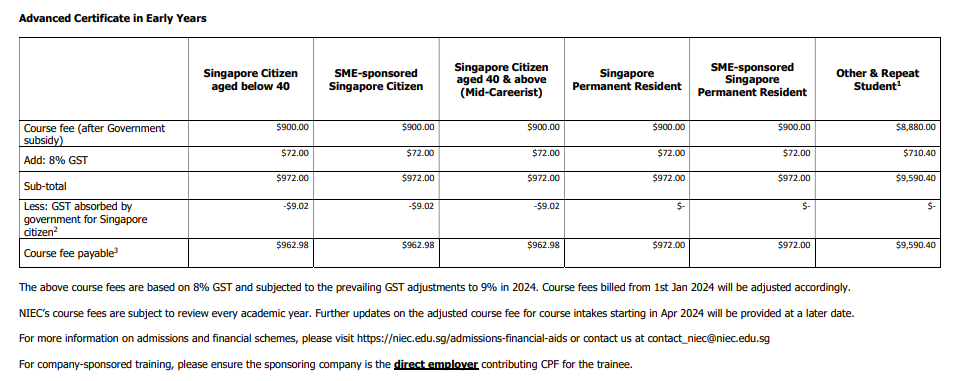
ACEY fees

For those with 3 O-level credits:

  • Advanced Certificate in Early Childhood Care & Education (ACECCE)

ACECCE is a 13- or 20-month course that will certify you as an L1 teacher. With ACECCE, you will be eligible to teach pre-nursery and nursery children from 18 months to 4 years old. Depending on the childcare or preschool needs, you may also be assisting K1 and K2 classes.

Course fees
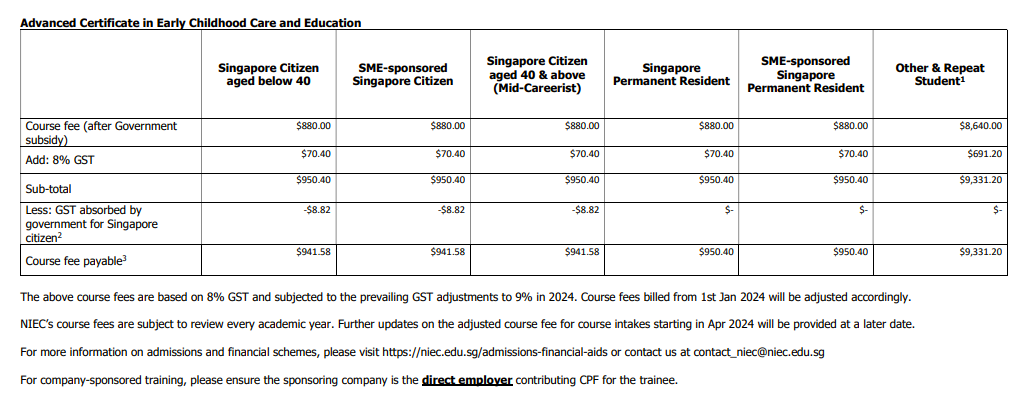
Advanced Certificate in Early Childhood Care and Education feesFor those with 5 O-level credits:

  • Diploma in Early Childhood Care & Education – Teaching (DECCE-T)
  • 幼儿教育专业文凭课程 [DECCE-T in Chinese]

DECCE-T will take 18 to 30 months to complete. Upon graduation, you will gain an L2 certification that allows you to care for and teach children aged 18 months to 6 years old. Those who do not have a minimum B4 grade for English Language (EL1) will need to obtain a minimum band of 6.5 in IELTS (General) or other ELAA within 2 years.

Course fees
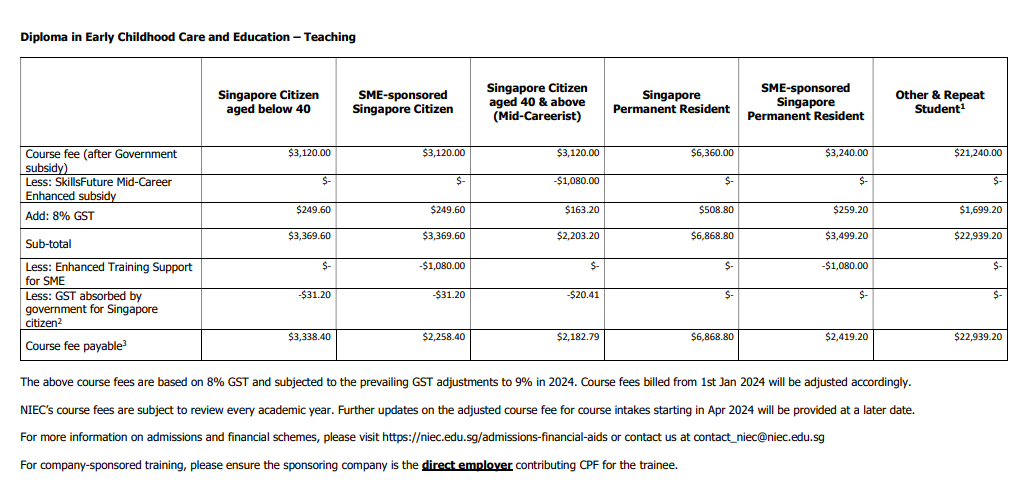
Diploma in Early Childhood Care and Education Teaching feesFolks with a degree or local poly diploma:

  • Diploma (Conversion) in Early Childhood Care & Education-Teaching [DECCE-T (Conversion)]
  • 幼儿保育与教育专业文凭(转业课程)[DECCE-T (Conversion in Chinese)]

DECCE-T (Conversion) is the last on this list for mid-careerist. It’s similar to the DECCE-T, except that it’s shorter in the training period. It will take you just 9 to 13 months to complete training.

Looks attractive, isn’t it? But as short as the training period is, be mindful that it’s going to be 10x more stressful since the knowledge that needs to be imparted to you is cramped within that short period.

I’ve seen friends and acquaintances undergo the DECCE-T while working at an early childhood center full-time and honestly, it’s not something I would want to go through. But if you’re serious about making that switch and don’t mind a stressful ride for long-term “gain”, go ahead!

Course fees
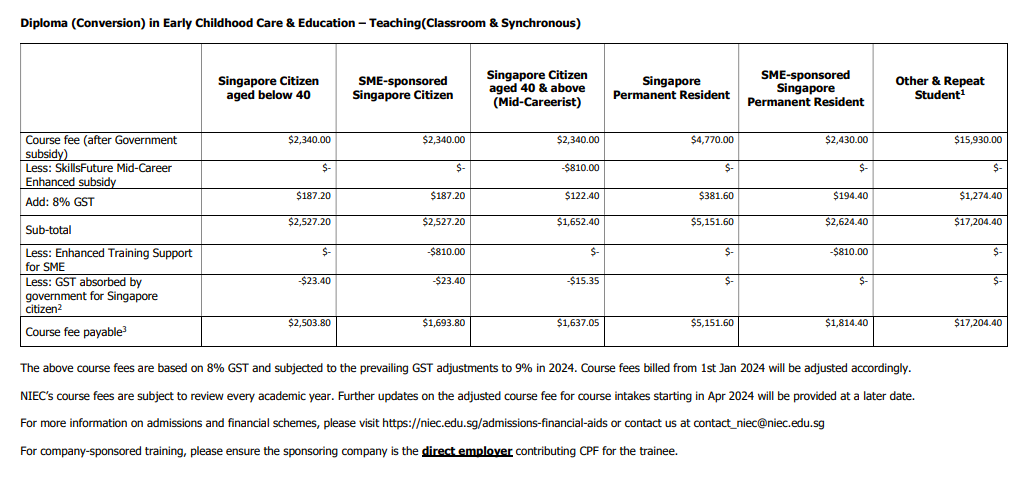
Diploma (Conversion) in Early Childhood Care & Education Teaching feesWhat if you’re not sure about making the switch?

Making a mid-career switch can be scary and if you’re 100% sure about being a full-fledged early childhood educator, I would advise you NOT to go for training just yet.

Look out for assistant teacher job opportunities first, where you play an assistant role to a trained teacher. By being an assistant teacher first, you will be aiding alongside the main teachers, which gives you a firsthand account of what your life is going to be like when you have to finally lead a class.

As with most jobs, being a “teacher” is not just about “teaching”. There are lots of things that go behind the scenes that most won’t see unless they’ve been through it. So I urge you to get yourself in the game first and give yourself some time to be fully immersed in the life of an early childhood educator before you decide if you want to spend that money/sign a bond and go for training.

Good luck with your new journey!

Read More...

Singapore Airlines conducting walk-in interviews for cabin crew on Saturday, 6 May 2023.

Are you looking for an exciting career that takes you around the world? Do you have a passion for providing exceptional customer service? Look no further than Singapore Airlines!

They are thrilled to announce their upcoming recruitment drive at Singapore Expo on Max Atria on 6 May 2023. They are searching for talented individuals to join their world-class team as cabin crew members. As a cabin crew member, you will be given an attractive salary package with allowances based on your flight patterns and flying hours. You will also have the opportunity to travel to any SIA destination once a year, meet new people, and provide the passengers with the best possible experience.

To get you started, they will be offering a comprehensive training program to prepare you for your role as a cabin crew member. You will learn essential skills such as safety procedures, customer service, and more.

Screengrab from Singapore Airlines’s Facebook Post

If you are ready to take the next step in your career and join a world-class team, you are encouraged to attend their upcoming recruitment drive at Singapore Expo on Max Atria on 6 May 2023.

To be eligible for the walk-in interviews, you will need to meet the following requirements:

  • Singaporeans only
  • Minimum age of 18 years old due to legislative requirements
  • Minimum qualification of 5 GCE ‘O’ Level credits (including English) or Higher Nitec and above
  • Minimum height requirement of at least 1.58m for females and 1.65m for males in order to carry out safety and emergency procedures onboard
  • Pleasant personality and service-oriented
  • Fluent in English with good communication skills

Successful candidates must be able to commence employment with them within three months from the date of application.

Application Details: The details of their walk-in interviews are as follows:

Date: Saturday, 6 May 2023

Venue:  Singapore EXPO Max Atria
Garnet 212
1 Expo Drive Singapore 486150

Registration will be open from 8.30am to 2.00pm. 

Interested applicants are requested to download and complete this application form in hardcopy. You will also need to bring along ALL the originals and photocopies of the following documents:

  1. Identity Card
  2. Birth Certificate
  3. Passport
  4. Marriage Cert (if any)
  5. Deed Poll (where applicable)
  6. Entry/Re-entry Permit (if applicable)
  7. All Educational Certificates
  8. Vaccination Report
  9. National Service Certificate and Transcripts (if applicable)

*For candidates wearing contact lenses, please come to the interview in clear contact lenses (i.e. no coloured contact lenses or iris enhancers.)

* Due to space constraints, candidates are advised to refrain from bringing companions to the interview. There will be no waiting area for those who are not attending the interviews.

For more information, visit https://www.singaporeair.com/en_UK/sg/careers/cabin-crew-career/

Read More...

How to Negotiate a Salary Increase in Singapore

Negotiating a salary increase can help you maximize your earnings in the Lion City. Although Singapore’s salaries are among the highest in the region, the cost of living is also high. If you are considering a salary negotiation, here are some ways to increase your confidence and make the task less nerve-wracking.

#1: BE PREPARED

Before entering any negotiation, it is crucial to do your research. Preparation can help you reduce your nerves. Research the industry’s average salary for your designation, the company’s financial performance, and any related economic factors.

You can use Salary Comparison tools online, which are designed to give you a comprehensive overview of key roles and their respective salaries. For instance, you can check out MOM’s Salary Comparison feature to compare your salary across organizations of various industries, establishment sizes, and employee types. This free feature comes with colorful graphs, which makes the information easy to understand.

#2: DESCRIBE YOUR ACHIEVEMENTS

When negotiating a salary increase, display your accomplishments to underscore the value you bring to the company. Highlight any projects you have led or have been involved with as well as the recognitions or awards you have received.

Do not forget to focus on the numbers! You can try to deny it as much as you want, but businesses revolve around making profits and growing numbers. Use statistics as direct proof of your contributions to the company. For example, in the past two months, I have brought in three new clients, which resulted in an 80% total increase in the company’s sales.

#3: IGNORE YOUR PREVIOUS SALARY

Ignore your previous salary. While it is always better to earn more than in your previous job, using your last drawn salary as a benchmark is by no means a good gauge. You have gained so much experience, skills, and knowledge since then. Instead, look at your objective value to the company.

#4: IMPROVE YOUR SKILLS

When talking about value, your added skills and abilities can help the company to flourish. Turn the tables into your favor by having appropriate education, expertise, and experience. Start by focusing on investing in seminars, workshops, and courses.

Best of all? Most of these resources are available at no cost. In the comfort of your own home, you can acquire Google and Microsoft certificates online. There are other online platforms that offer free courses such as Centre for Excellence and Coursera.

#5: BE SPECIFIC

When stating your intent for an increase, you need to be specific and provide a realistic range. This will give the company some flexibility in meeting your expectations while also opening the floor for negotiation.

#6: CONSIDER OTHER BENEFITS

As an HR Consultant, I often give a brief background about the company and emphasize its company benefits to draw candidates closer to the organization. If your company is unable to meet your desired salary increase now, you can consider negotiating other benefits such as flexible working hours, childcare allowance, improved health plans, training opportunities, or additional vacation leaves. Can you imagine having your company shoulder half of your childcare fees or overseas workshop costs? These benefits add to your overall compensation package.

Image Credits: unsplash.com

BOTTOMLINE

In conclusion, negotiating a salary increase can be challenging. However, with sufficient preparation and the right approach, it can also be a rewarding experience. Remember to do your research, highlight your accomplishments, be specific, invest in knowledge expansion, and consider other benefits. With these tips, you can successfully negotiate a salary increase and maximize your earnings in Singapore.

Sources: 1 & 2

Read More...

Are you okay with your boss following you on social media?

social media apps

Aha.

A tricky question to tackle on 4.4.

While it’s not uncommon for bosses and employees to become “friends,” or rather, have a friendly relationship outside of working hours, being on social media can be a little…

Ehem.

Up to this point, some of you may be secretly laughing inside since it seems like a no-brainer.

“Aiyo, just don’t post anything you won’t say in front of your boss lah.”

But hey, isn’t that an invasion of privacy? It’s social media after all, and not connected to work. Isn’t it stressful to have to “censor” yourself because your boss is part of your friend/follower list?

Let’s delve deeper into this.

What are the downsides?

Numerous.

Since bosses will be able to see what you “like” and your comments on posts, they may form an opinion of you that may not be part of your “professional reputation.”

And if you’re friends with your colleagues, that’s extra stuff to worry about. But but, we won’t get there for this post. Simply put, life is stressful enough to have to worry about what you post online.

Play around with privacy settings

Not all social media platforms allow you to play around with privacy settings. For example, TikTok and Instagram probably can’t (unless you go private).

But for Facebook, you can limit who sees your posts. I mean, if you have no choice but to accept that friend request from your boss, you’ve got to take some safety measures, isn’t it?

Though it would be a pain in the a** to have to constantly keep this at the back of your mind—being careful with what you share and whom you share it with.

What to do when things don’t go your way

Called in sick and took a day off on Monday but posted that photo of you drunk on Sunday night?

A cliche scenario, but it happens.

If you find that things don’t go away no matter how careful you’ve been on social media, take this chance to disconnect.

And when asked or questioned, just explain that you think it’s better to draw the line between personal and professional.

Is it really a no-no to connect with your boss?

Well, not really.

This is especially for people who don’t have much of a social life. Oops, I’m sorry to be blunt but it’s true.

Or for folks who tend to be on social media to “stalk” or get updates on events, friends, and loved ones.

In such cases, then it’s okay to connect. In fact, you might be on the “winning end” because you will be stalking your boss’ social life instead. Ha!

Jokes aside, I have a few friends who are on social media to showcase their work—designs, and drawings—so there are no danger zones there yeah.

As we close, just know that accepting a request without putting much thought into it may be disadvantageous to you. Ultimately, a boss is a boss and professionalism should come first in the majority of your interactions. Why sabo yourself?

Read More...

Strategies to ensure everyone on the team contributes equally

team meeting

Managing a team is never an easy task.

You can curse out your ex-manager for being this and that but truth be told, it’s a challenge. And now that you’re in a managerial position, are you in a dilemma?

How on earth do you ensure that your team members are contributing equally? Well, we will be delving deeper into this topic in this post. So buckle up, and let’s roll.

Invest in team building

Depending on companies, some management groups think that team building is necessary at least once a year.

For me, I guess you set your own rules—once every quarter isn’t that bad. If it’s too much, then go for once every 4 to 6 months.

Team building is a good investment if you want a cohesive team. Duh. How can anyone work together in harmony if they don’t know each other well, don’t have common topics to talk about, or don’t see eye to eye?

Have clear sub-goals

Anyone who has walked into a project managed by a manager who does not know how to create clear objectives knows how it feels.

GG.

No, not good game, but good grief.

If you want every member of your team to get a slice of the pie, then make sure you map out your overall objective(s) and concrete sub-tasks.

For example, if you’re a team working on launching the latest summer collection of a fashion brand, then make sure every headcount involved in the project knows what they are doing. From the most senior executive to the newest intern, everyone should have a defined (quality, not quantity) task to work on.

And yes, keep those deadlines in check too.

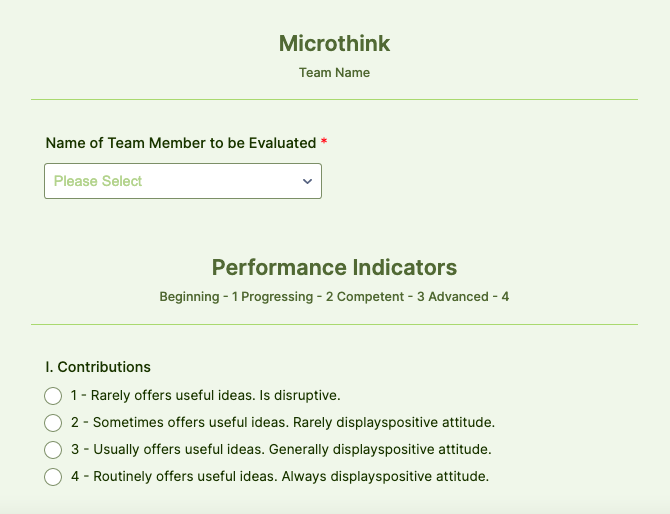
Create an evaluation system
sample peer evaluation form

Image Credits: jotform.com

I’m not going to lie, I’m not a huge fan of evaluations. Why? Because it keeps me on my toes.

Knowing that I’m being “watched” not just by my boss but also by my colleagues leads me to pull my weight a little more.

So if you’re a manager who wants to play around with some psychological motivational forces, focus your attention on these:

  • Step 1: Peer reviews

To ensure that peer reviews work and not harm, it has to be done right.

I suggest making peer reviews anonymous. Whatever means you use to evaluate—the old-school way of paper forms or online ones—the only person that should be able to view those feedback would be you, the manager.

There’s no need to, as the Chinese saying goes, 挑拨离间 (sow discord).

  • Step 2: Analyze feedback

Once you’ve gathered fellow responses from your team, it’s time to analyze them.

Anonymous peer feedback is the best feedback if a certain point raised is rather consistent across teammates.

For instance, you may get comments such as:

“Meixin is quite slow in the work assigned to her. She doesn’t keep to deadlines.”

If just one person raises this point, then maybe it wouldn’t be that credible. But if you have a team of 10 and more than half has somehow or rather given such feedback, it shows something.

But I understand no one has the time to do such detailed feedback like that all the time. Maybe twice a year or once at the end of the year may work. Or you can consider using automated tools to track project progression and workflow completion ratios. This is wiser for managers who have to take care of >1 team.

In a nutshell, we have raised 3 main strategies in this article to ensure that everyone’s pulling their weight in the company. As a manager, the responsibility is on you to build a team that can work together. While you can’t guarantee everyone will like each other, teamwork can be built based on respect and regular conversations. And don’t forget to always pen down clear tasks for your teammates to work on. Lastly, have an evaluation system in place so there’s a proper outlet for peer reviews that can help you gauge the strengths and weaknesses of each team member.

Read More...