Most bachelor’s degrees take a substantial period of between 3 and 4 years to complete while the steep cost of higher education is enough to wipe out 1 to 2 years’ worth of income (if you decide to take a local degree). Therefore, pursuing a bachelor’s degree is in reality both a time-consuming and financially taxing affair.
To make things worse, some students may realise that they have lost the passion midway through college or could not sustain their enthusiasm for long after graduation. Consequently, they do not find the jobs that are relevant to the skills and knowledge they have painstakingly acquired in the university. This results in a significant wastage of useful resources at the societal level.
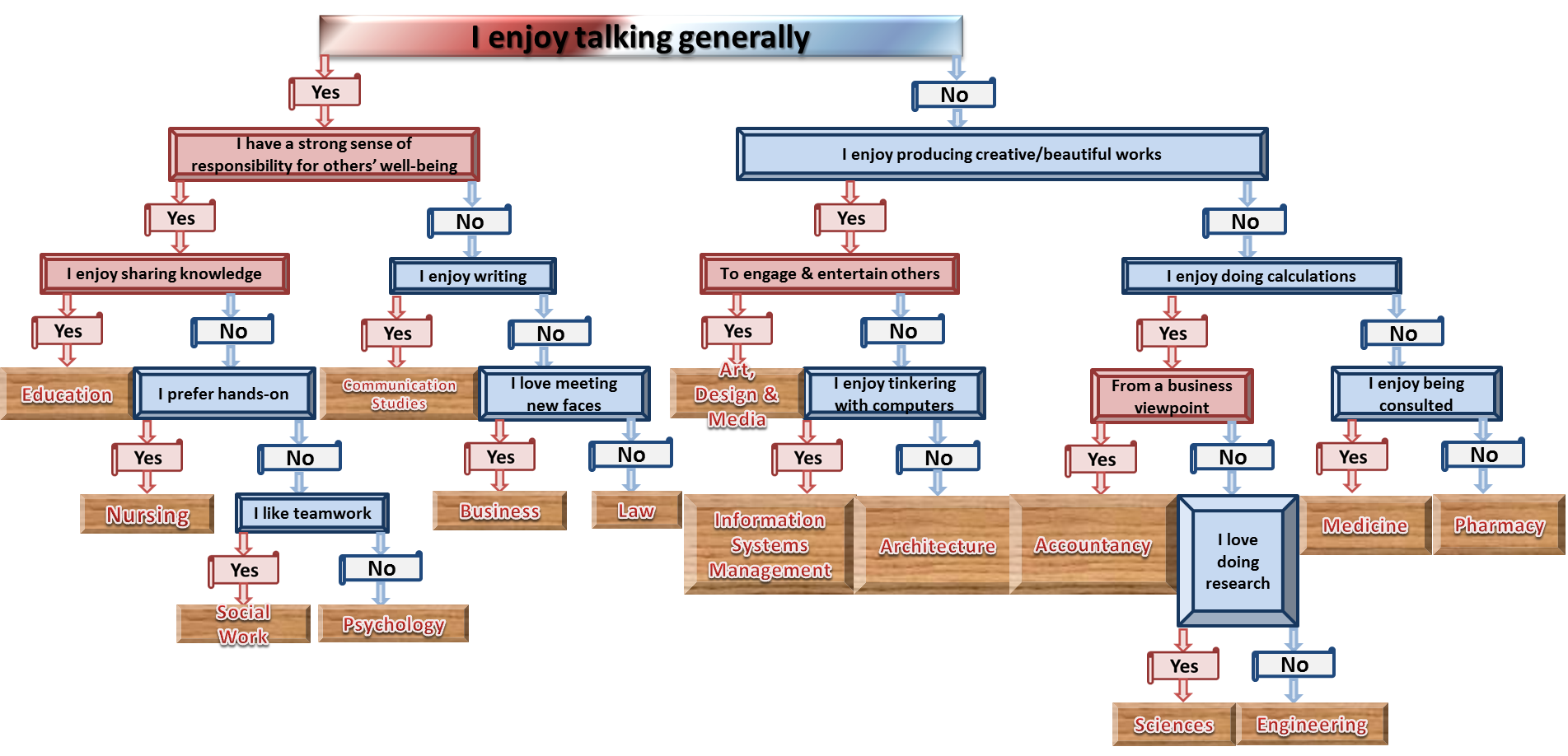
From a rational point of view, it is thus in the best interests of both the society and the individual to assess the compatibility between oneself and the particular programme. Specifically, undergraduates can maximise their economic gains from such a hefty investment by patently understanding their likes and dislikes before committing to a particular course of study.
Click to enlarge:
Disclaimer: This is merely used as a quick reference guide.
Asking for a raise is like breaking up. There really isn’t a “best time” for it, and a lot of awkwardness will be involved. Unfortunately, our success in life corresponds to the number of awkward conversations we’re willing to have. So if you want to climb out of that low income rut, you’re going to have to bite the bullet and ask–but do it the right way:
The Three Rules of Asking for Money from Your Boss
The first thing you have to do is make sure you don’t break any of these. If you do, the chances of failure are not only exponentially higher, but the consequences will also be steep. Even if you do win your raise while breaking these rules, you will incur the resentment of your employer and could pay for it throughout your career.
Always signal your intentions. Always give your boss forewarning. Drop a polite note saying you would like to set a time to discuss how you’re being compensated. If you corner your boss at the water cooler and ask for a raise, 99% of the time the answer will be “no”, or a polite brush-off.
Prepare justifications based on results, not on how hard you worked. You will need to make a list of achievements before negotiating. “Achievements” are not the number of hours you worked, or the personal time you’ve given up (we hate to tell you this, but most employers don’t care). Achievements are how much money you’ve made for the company, how you improved a product or service.
Always have help. Find a team or department leader whose schedule would be badly affected by your departure, and tell them about it first. If someone relies on you for budget reports, for example, tell them your plans to leave if you can’t get a raise. And then ask them to back your credentials when you negotiate with your boss. Here’s a secret: whether you get a raise is often dependent on how hard team leaders fight for you, not just how hard you fight for yourself.
Timing the Moment
Obviously, the best times should be just after a good performance review, or after a successful project. But things are seldom so convenient, so look for the following times instead:
Wait About Three Working Days after Informing Your Boss of Your Intentions
As mentioned above, never corner your boss and discuss your raise on the spot. Send a short e-mail or, even better, meet her face to face and ask if you can talk about your compensation “later this week”.
Three days is a good interval, which will also give you time to prepare what you need. It will also give your boss time to reflect on your contributions.
Ask about Two Weeks after a Big Win
Use the “halo effect”. When your department or you have performed well, you are in a good position to negotiate a raise. However, don’t do it immediately, as it will be too obvious that you are trying to capitalise on it.
You’ve Just Heard the Report on Your Employer’s Financial Health
If you just heard a rah-rah report about your company doing better, try to time your request close to date you heard it. You can also obtain this information from a prospectus or annual report.
It is better if you make the request after it has been announced however, since it’s harder for your employer to use lack of money as an excuse.
You’ve Checked and Compared Your Earnings
Use sites like Payscale to check your earnings compared to your peers. You might even want to go so far as interview for positions in other companies, to see how much they are willing to offer. In general, you are right to ask for a raise if you are on the low end of the pay scale (bottom 50%). If you are already on the high end of the scale, you had better have some kind of massive achievement of late to justify the request.
If the timing is right and you’ve prepared the right details, then go ahead and make your move.
Just remember though, if you do get a raise, don’t go crazy with it. Your first priority should be to pay down any credit card debts that you have. Your credit card should be saving you money, not costing you money. If that’s not the case, drop by SingSaver.com.sg to compare and find the best credit card for your needs.
Some of us are hesitant or skeptical toward Financial Consultants. To increase your knowledge on this subject, what do Financial Consultants actually do on a daily basis?
In general, Financial Consultants are professionals who guide their clients to manage their money, investment options, and asset relocation. But, what they do is far more complex than that. A career as a Financial Consultant gets to enjoy the flexible working hours and the privilege to indulge on the job incentives (e.g., Free Trip to Australia). Thus, the freedom will help them spend more time with their treasured family and friends. It can not only be challenging as they face a lot of rejection but also rewarding as they see their clients improving their monetary lifestyle. There is a job growth in this field as long as you go through continuous training with determination and openness.
Especially in large companies such as Prudential, HSBC, etc., Financial Consultants are:
a. Financial Planners
b. Dependable Advisors
c. Monetary Coaches, and
d. Financial Solutions Provider.
Financial planning entails creating the client’s financial goals by determining the shortage and the actual financial situation. Then, trusted advisory includes managing cash flow and developing money management strategies. While, Monetary coaching entails guiding clients to save more and to motivate them to avoid procrastination. Lastly, Providing Financial Solutions includes offering affordable solutions and options to achieve one’s financial goals.
Financial Consultants are more than just insurance salesmen because they organize your finances after identifying their financial needs and providing them with valid options. All these are given within a practical timeframe. Furthermore, the relationship established with you does not end after the “sale” is done. Financial Consultants are responsible for regular follow-ups to ensure that your needs are taken cared of. In short, they are committed before and after sales.
Image Credits: State Farm via Flickr with CC License
The Straits Times recently published an article on “Why a safe job is risky business for Singapore”, which urged young job seekers to change their mindset about the risk and remuneration issues apparent in local Small and Medium Enterprises (SMEs). While these are common issues faced by SMEs which often have limited resources to offer competitive salaries that may inevitably compromise their company’s growth, it is time to rethink the prevailing practices surrounding employment and compensation. Indeed, considerable funding support from SPRING such as the SME Talent Programme for SMEs should provide a strong impetus for SMEs to strengthen their competitive edge in today’s dynamic and rapidly evolving world by offering pay packages commensurate with each individual’s qualifications, experience and competence.
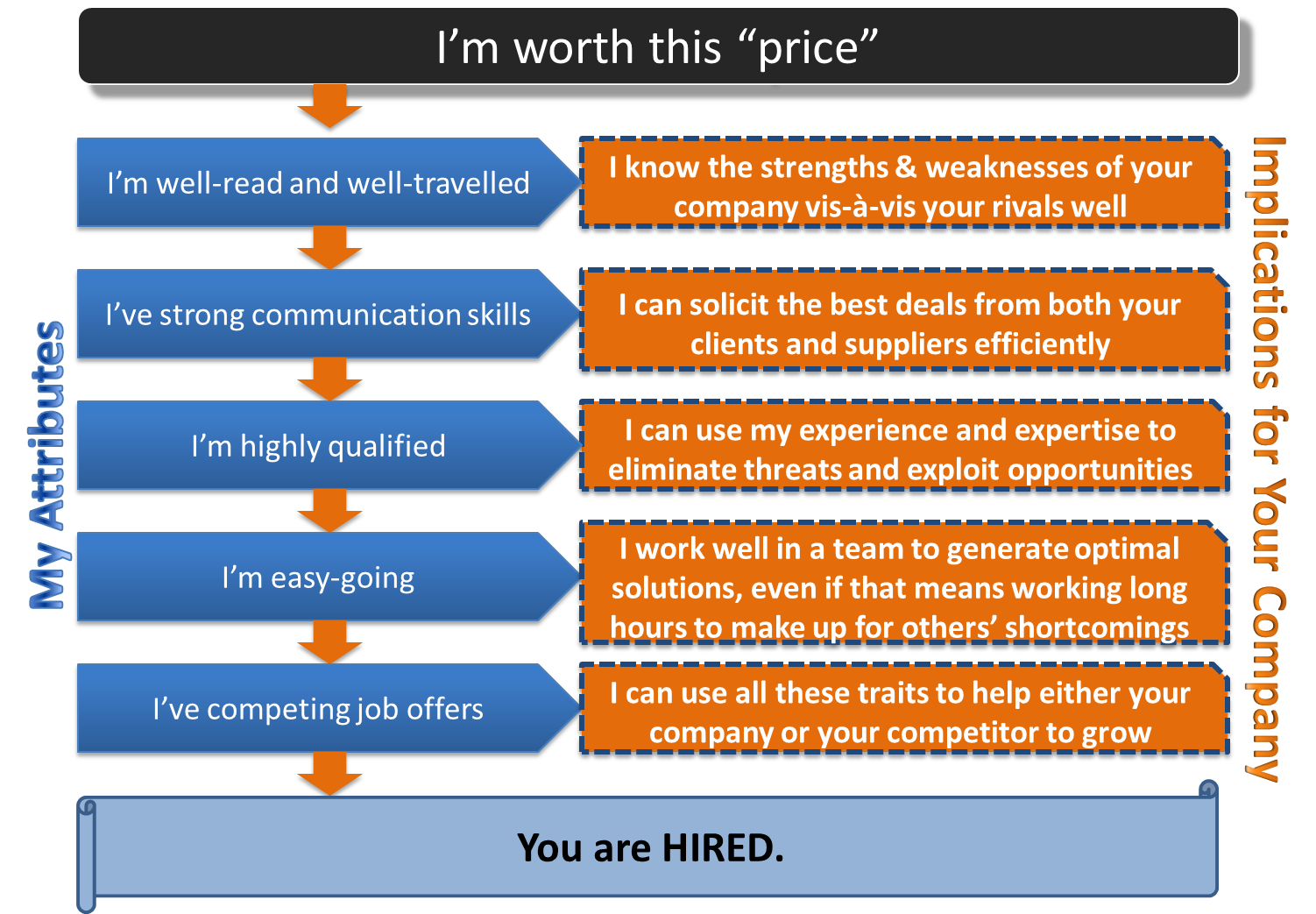
To all job applicants: It is not too late to “flaunt” your attributes, but please convey your gifts in a measured way. The diagram below just serves as a reference guide.
To the employers: It is never too late to start appreciating your potential hires’ talents that may prove invaluable to your company’s development and progress.
A common misconception of introverts is that the dislike socializing. Contrary to the popular belief, introverts are drained by social interaction. Many introverts can socialize easily…they just prefer not to. So, as long as the job does not require tons of socializing face-to-face then, it is suitable for an introvert.
In fact, certain jobs that require extensive research and great listening skills are better off with introverts. That said, here are a few of the highest paying jobs that introverts can excel on:
4. COMPUTER PROGRAMMER
Average of S$47,399 per year
It is common sense that one of the most in demand jobs today is computer programming. Diving into computer programming requires knowledge on Computer Science or Information and Technology. It involves lifelong learning of the constant evolving technology and coding. As a computer programmer you will spend countless of hours in front of the computer while having minimum real-life interaction.
3. SOCIAL MEDIA MANAGER
Average of S$47,642 per year
With the overflowing dependence on digital technology, businesses all over the world had been hiring social media managers to enhance their marketing strategies. All you have to do is to spend most of your time online with minimum real-life interaction. Visual interaction is done through answering the feedbacks of Twitter followers or Facebook fans. Having your own nest at home while earning money makes this job perfect for introverts!
2. STATISTICIANS
Average of S$53,238 per year
Statisticians are focused on the collection, analysis, interpretation, and presentation of quantitative information. Rather on contemplating about the conversation topics, they rely on numbers for small talk. This job is rewarding for introverts, not just because they are paid well but also because they are mostly immersed in spreadsheets and equations alone.
1. GEOSCIENTIST
Average of S$120,000 per year
Interestingly, the highest paying job on the list allows more interaction with the environment than with people. Geoscientists can specialize as geophysicist, geochemist, hydrogeologist, geologist, and sedimentologist. Learn more about this introvert-friendly occupation, here: