What is your idea about passive income? For most people, passive income provides an opportunity for freedom and independence. It gives an escape from our 9-5 jobs that occupy most of our week.
There are different ways to generate income while you are “sleeping”, here are just some of them:
START A BLOG
If playing with words comes naturally to you, you may find passion in writing. Establishing your own blog is quick and easy to do. Simply purchase your own domain or create your own website at no-cost thru website builders such as Wix.
Equipped with your glistening blog, you can either sell your stuff or share your expertise to earn some legitimate cash on the side.
CONSIDER P2P LENDING
Let’s face it! Banks do not lend money out of sheer kindness. They do it because it is profitable. Get a taste of the action by joining P2P websites, which allow companies from around the world to loan money from private people.
P2P Lending is highly attractive to both the borrowers and the lenders. Firstly, P2P Lending loan qualifications are more relaxed than that of given by the banks. On the flip-side, lenders can reap the benefits of up to 20% per annum.
INVEST YOUR MONEY
If you have money to spare, consider investing your funds to grow your nest. Let the company work for you as you receive dividends from them. Directly owning a stock in a company or through a fund enables you to receive dividends. A dividend is a cut of a portion from a company’s profits.
Image Credits: pixabay.com
The amount of money you receive depends on how much stock you own and how much profit there is to divide. Ultimately, the rewards that you will receive are decided by the board of directors. Do prior research before committing to a company.
In the hustle and bustle of the city life, Singaporeans are exposed to the high economic pressures. What makes this concrete jungle thrive? Money, of course. Putting matrimony into the mix makes things more complicated.
Managing money is a complex task fraught with emotion. It is natural that conflicts can arise from time to time. To keep your marriage and finances in tact, open communication and teamwork are essential. If only more couples are having regular conversations about money issues before and after walking down the aisle then, we will less likely to have divorces.
MONETARY IMBALANCE
What will happen when there is a massive earning gap between partners? Or, when a spouse comes from a wealthy family and the other came from humble beginnings? More so, living in a single-income household is not uncommon. Sometimes, the imbalance between two people creates power play.
When power play occurs, the person who earns the most dictate the spending habits of the other. He or she will have personal spending priorities in mind. The other partner simply complies.
Handling this situation is tricky. You can either make a pre-nuptial agreement or open a joint account. Nonetheless, marriage should be founded by cooperation in all aspects.
OPPOSING PERSONALITIES
In the list of reasons why couples divorce, money is among the top answers. Friction brought by money can be due to the opposing personalities of two people. Personality towards money plays a vital part in a couple’s marital bliss or the lack thereof.
Imagine living 24/7 with a hoarder when you are a spender yourself. Or, living with someone who is a risk-avoidant when you are a risk-taker yourself. To the extreme, you may live with someone who believes that the person who dies with the most money wins. These opposing personalities can be mediated by empathy. Walk in the other person’s shoes to understand where he or she is coming from. You may also adopt your spouse’s money habits for a month to see how it works. Paying attention to money habits before and during matrimony can be beneficial. Talking about your financial views and feelings can help put both of you at ease.
OVERWHELMING DEBT
From school loans to shopping addiction, many people come to the altar bearing a financial baggage. If one partner has an outstanding mountain of debt and the other does not, this situation can spark a conflict.
In such situations, people often take solace in knowing that debts are not carried over thru the marriage. However, it is understandable to share the responsibility over housing and child care debts.
Knowing what you are getting yourself into can help you decide how to deal with it. Both partners have to be honest and non-judgmental when discussing about their financial habits and bad records. Apply several payoff strategies soon after. And, seek professional help when needed.
Like most people, you are searching for the best way to fall on the right money management track. Falling behind your money-saving goals can feel discouraging, but it’s never too late to start learning some money-saving strategies. Throughout our lives, the relationship we have to money is dynamic. We have different needs and different spending habits. If you were never paying attention to your money-making and money-spending habits, this is the right time to start.
To organize your strategy, follow the tips below. They have been tested and proven to work on multiple occasions.
Keep a closer eye on your expenses
You know how much money enters your accounts monthly, but are you fully aware of how much you spend? Keeping a closer eye on your expenses will help you identify areas where the money is spent unnecessarily. You want to know how much money you spend monthly, and you want to keep tabs of your expenses. If you’re reluctant to keeping tabs manually, consider downloading one of the numerous expense trackers online. Alternatively, you can create your own expense spreadsheet.
Still, tools like Mint.com or Tink are amazing starting points in your expense tracking journey. Some apps can even offer you small synopsis of your spending patterns. With all that information, you will be able to make better money-management decisions in the future.
Once you get deeper insights on your money spending habits, you can start to outline a budget plan. Monthly budget plans will offer you a clearer idea of how your financial situation will look like in different stages of the month. When you notice discrepancies between your plan and actual budget, adjust the first. This will ensure you are in touch with the financial reality of your household, not the theory in your plan.
To outline an accurate budget plan, include your fixed monthly expenses: utilities, cell phone bills, car insurance, rent, or mortgage payments, and so on.
Take into account variable expenses, as well. Things like gas, personal care items, and one-time expenses are also important when creating a monthly budget plan.
Don’t forget about your savings account! If you don’t have one, this might be the perfect time to open one!
Establish a clear list of financial goals
Without clear financial goals you want to achieve by creating better financial habits, you are unlikely to work things out. Your financial goals can be anything, from saving up for a home down payment to paying off a debt, to saving up for a car or for a retirement fund.
Maintaining a clear list of goals will make you focus more on achieving them. It will also help you handle your finances more carefully. Being fully aware of your financial goals will also contribute to making better financial decisions. You will be more balanced between your spending and saving habits, and you will be more motivated to find extra income streams.
Invest
Investing is a clear way of making extra money. When the money coming from a single income source is not enough to pay your monthly expenses and saving, additional streams of income can help. Financial advisors come with several investment suggestions that are proven to work. The most efficient seems to be Forex trading. Before starting your trading journey, research Forex low spread brokers. As expert traders explain, they are the most advantageous for rookie traders. Low-spread brokers are those offering the smallest difference between the Bid and Ask price. This means you can buy currencies at lower prices and sell them for higher amounts. The benefit of choosing such brokers is obvious here. Your profits will be higher, in this scenario.
Have an emergency fund
Financial emergencies are not pleasant, but they can appear at all times. Having an emergency fund for such situations will help you keep your savings untouched. Medical visits or car emergencies involve huge amounts of money.
Establish how much you want to put in your emergency fund. This will only depend on you and your financial abilities. However, the more you put in this account, the better. According to financial advisors, those who still struggle with debt should aim to have at least $1,000 in their emergency fund. Others claim that you should have at least 3 to 6 months of your living expenses in your emergency fund. It mainly depends on your ability to save so much or not.
Try to figure out how much your household is comfortable with saving for this purpose. Saving something, no matter how little, is better than finding yourself without any money in emergency situations. For the beginning, set aside $5 or $10 for emergencies, weekly. If you’re comfortable with it, increase the amount periodically.
Prioritize expenses
All people have to prioritize their expense. Ideally, your spending habits should align with your values. Do you care more about buying a new kitchen appliance, or about your summer vacation? Pick between the two. Apply the same principle to all your expenses, and you will be more likely to save money, in the long run. Apparently, financially well-off people seem to value more experiences over physical things. You could try to implement the same strategy. Because new physical things appear frequently today, obsessing over them will only lead to higher expenses. Prioritizing experiences and things that bring happiness, in the long run, is more rewarding and less expensive.
These are the basic ideas and tips recommended for people who want to save some money but are not as experienced in the matter. Your money-saving journey can begin today. It’s never too late to pick up healthy money management habits. Go at your own pace and you will be more likely to succeed. Avoid letting external pressure guide your decisions and only make those moves you are comfortable with. Of course, the rest of your family should follow your lead. Saving money as a family is more effective but it can also be more difficult to manage.
As a parent, you must guide your children’s path to financial independence. Fortunately for you, there are available online tools that can help. Start knowing your teen’s financial personality through the Financial Identity Quiz. It is a research-based tool for teens and young adults aged 16 to 24.
After determining your child’s designated identity, you must discuss its advantages and disadvantages. Give some scenarios to help them decide better.
IDENTITY 1: THE PATHFINDER
As the name suggests, Pathfinders are committed to explore their own financial paths. This does nor mean that they do not need your guidance! From time to time, you must encourage thoughtful discussions about their financial goals. Where are they headed?
To give a distinct financial path, you must challenge your child to look for a positive financial model. It can be a professor, a blogger, an author, and so on. Discuss the steps taken by your child’s financial model. How does he or she plan to achieve the same path? Start by applying similar money principles as your financial model.
IDENTITY 2: THE NOMAD
Some people know their direct paths to success and others are still exploring. Not all those who wonder are lost, but the Nomad needs a little structure in his or her financial life. Help shape your child’s financial habits by finding an ideal financial path together.
Ask your child to do his or her research on a regular basis. You can train this by giving scenarios. For instance, ask what he will do if he showed up to an event without enough cash. Will he panic when faced with late fees via a credit card billing statement? Will he ask for your help when he missed a deadline for a school activity? Also, where will he buy gas when all the petrol stations are closed? These experiences can turn to teachable moments about financial obligations.
IDENTITY 3: TENDERFOOT
You may know a friend or two who has a Tenderfoot approach to money. A Tenderfoot has the most to learn when it comes to making financial decisions. You see, this type is so careful and conservative. This can be a good thing! However, being too careful can make you miss out on other opportunities. You need to take necessary and responsible risks along the way!
Help your children make their own financial decisions by asking what they will do when they are living on their own. Will they have a roommate or live with each other? What if they had an unforeseen medical bill or job loss? How will they raise enough money to survive? Discuss what they will do when help from a parent or a guardian is hard to reach. They have to take risks on their own.
IDENTITY 4: TROOPER
Last but not the least is the personality that echoes you the most – the Trooper. It is flattering to have your child follow in your footsteps. However, you also want to guide your beloved to make his or her own mark. What would be right for you might not be right for your child. Help your child to take ownership in money matters through discussions.
Image Credits:pixabay.com
Ask your child about the last time when he or she acted independently. How did it turn out? What was the problem and solution? How did he or she felt after taking the bold action alone? Then, make your child write down a list of personal priorities that he or she would accomplish alone. These priorities will be best accompanied by research. Help your child know which decision is the best one.
The Open Electricity Market (OEM) has allowed households to switch from SP Group to other retailers to trim their electricity bills. While this has been a fantastic ride so far, it would be even better if households can make the switch with certainty on the following:
Knowing the unit rate to be paid across the entire duration of the contract
Enjoying the highest saving rate across the type of plans available
With so many fixed rate plans being offered in the market, consumers actually need to look no further than Senoko Energy LifePower24 Fixed Rate Plan to get the most bang for their buck. It offers one of the highest cost savings for a fixed price 24-month contract.
Senoko Energy LifePower24 Fixed Rate Plan
Senoko Energy LifePower24 Fixed Rate Plan is a 24-month fixed price contract where consumers pay only 17.78₵/kWh (price includes GST) instead of SP Group’s current regulated tariff of 24.39₵/kWh. This extremely low unit price is fixed for the entire duration of the contract. Furthermore, additional savings are thrown in as well:
$60 bill rebate;
Up to $50 one-time cash rebate for recurring payments made at Senoko Energy’s partner banks;
Up to 5% monthly bill rebate for recurring payments made with OCBC, Standard Chartered or UOB. Find out more about their bank partners here.
With such a low unit rate fixed across the duration of the entire contract, coupled with the excellent freebies thrown in, this makes Senoko Energy LifePower24 Fixed Rate Plan one of the lowest cost 24 months fixed rate plan in the market.
Highest savings amongst OEM Retailers for HDB 3/4/5 rooms, Condos and Landed properties
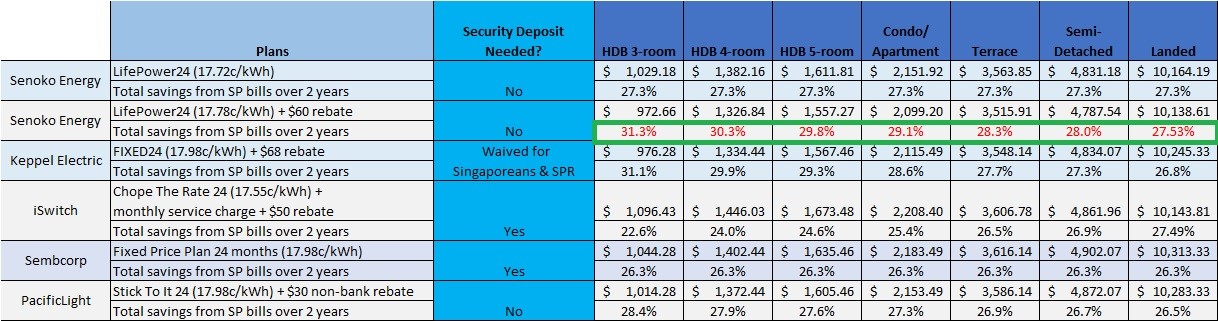
To illustrate why Senoko Energy LifePower24 Fixed Rate Plan is the lowest in town, let’s make a comparison across OEM retailers offering 24-month fixed rate plans based on SP’s average household electrical consumption.
Click on image to enlarge
Rates above are accurate as of 22nd May 2019.
Comparison are based on 24-month fixed rate plans with bill rebates factored, applied on national consumption patterns by dwelling types. Bank rebates are not yet included.
As seen in the above table, a comparable household staying in a 4-room HDB will enjoy 30.3% savings in electrical bills by switching from SP Group to Senoko Energy LifePower24 Fixed Rate Plan. The most important conclusion is that whether you are staying in a HDB 3-room or a condo apartment or even a landed house, Senoko Energy LifePower24 offers the highest savings rate amongst the OEM retailers compared. More importantly, Senoko Energy does not collect a security deposit when you make the switch.
Sign Up Now for up to $110 Bill Rebate
To milk the most out of this opportunity, consumers should quickly sign up for this limited-time promotion to enjoy up to $110 rebate. Hurry to lock in both the unit rate of your electricity bill and the greatest possible costs savings available in the market. Give your household the peace of mind and sign up with Senoko Energy LifePower24 Fixed Rate Plan now!
Legal Disclaimer: It is still important to exercise due diligence when choosing your retailer, so be sure to read the fact sheets and fine print.