What On Earth Is A Sharing Economy?

Is it possible to live in a world where you can carpool with a stranger during an emergency? How about dining at someone’s home or hiring an experienced chef with a swipe of a finger?

With a “sharing economy”, all these are possible!

According to Investopedia, a sharing economy is…“an economic model in which individuals are able to borrow or rent assets owned by someone else. The sharing economy model is most likely to be used when the price of a particular asset is high and the asset is not fully utilized all the time.”

United States, Europe, Seoul, Australia, and other parts of the globe have shifted from a consumer market to a sharing one. In these places, people use technology to rent, lend, and exchange goods and services rather than purchasing them from shops or companies. Considering the scarcity of some resources in the country as well as its technological advancements, experts suggest that a sharing economy is an untapped realm with great potential for Singaporeans.

April Rinne, a consultant and World Economic Forum Young Global Leader, expressed that a sharing economy can help a society to become more sustainable. And is it not what Singapore aims to accomplish?

In fact, in the Sustainable Singapore Blueprint 2015, the state set up a collective vision that includes being a zero waste nation by 2030. A sharing economy fosters activities that enable people to share and earn income from underused assets such as apartments, cars, clothing, and tools.

There are several benefits that a sharing economy can bring to a nation such as reducing environmental waste impact, redefining the materialistic ideal, increasing efficiency in transport, as well as cutting energy and water consumption.

Sharing economy helps to reduce the environmental waste impact and extend the longevity of items. For example, The Freecycle Network™ allows people to give and receive re-usable items to divert them from the landfills. 9,104,727 users post ads of pre-loved items and give them freely to people that would want to take it. Interestingly, I saw one post from Singapore that offered “lofted twin beds with desks underneath”.

A sharing economy also helps to redefine our materialistic ideal as it encourages to sell or share our possessions. You see, we grew accustomed of having material goods as a measure of success. We believe that the more we have, the more society will perceive us as wealthy and happy. But the truth is, having all these designer goods or lavish cars will never satisfy us. It will only make us craving for more. In a sharing economy, you can easily buy and rent clothes online.

Aside from sharing our possessions, a sharing economy supports the idea of community transportation. By community transportation I mean that people can rent cars from companies, carpool with strangers, and pay for a ride from the people in their neighborhood. A good model for this is Uber. Uber allows you to get a taxi or share a ride with other people through a mobile service.

Lastly, a sharing economy allows you to cut on the accommodation costs as well as energy and water consumption thru services like Airbnb and Couchsurfing. In 2014, a study found that sharing homes had considerably lesser energy and water consumption, greenhouse gases, and accumulated waster compared to hotels. The current situation of home sharing in Singapore depends on the Urban Redevelopment Authority (URA). The URA is re-assessing the law which considers that it is illegal for an individual to rent out their home for stays shorter than 6 months.

Image Credits: pixabay.com

Image Credits: pixabay.com

For individuals, companies, and the society at large, a sharing economy presents a myriad of opportunities to invent new streams of revenue, solve social issues, and to create community resilience. If this idea is successfully achieved, Singapore can just boost its productivity levels significantly.


Sources: 1 & 2

Read More...

Effective Ways To Teach Teens About Investing

Money gives people, of all ages, the decision-making opportunities they need. Educating your teens to make wise money decisions earlier on will affect their finances in the long run. One of the most important things you must do is to expose your daughter or son to the basics of investing. In hindsight, I wished my parents did so.

1. ENLIGHTEN THEM ABOUT YOUR FINANCES

Embedded in our Asian culture, most Singaporean parents keep their financial issues away from their children. However, the teenage years is the perfect time for you to enlighten them about the “real world” and its problems. Keeping your teens in the dark will make them think that managing money is easy and life is perfect.

Help your teenage child to transition from being a clueless kid to an informed young adult by teaching how important it is to set up future goals and a working budget. Take the effort to share your financial experiences including the ones that are related to investing. Be ready to answer countless amount of questions too!

2. PUT VALUE TO THE CURRENCY

Explaining the importance of money is easier said than done. With the idealistic minds of most teens, you must level it down to reality by giving relatable examples. Put worth or value to the currency by telling them that the money they saved and invested can be used to buy concert tickets of their favorite bands. It can also be used to buy the latest gadget that they have been eyeing on.

Make them realize that when money is invested in the right place and in the right way, they can purchase not just one but probably a couple of the things that they need and want.

3. START WITH THE BASICS

Similar to learning how to ride a bicycle, begin by attaching the training wheels. In this case the training wheels are your investing fundamentals. Explain your own investment philosophy and the way you invest. Then talk about the basics of how the stock market operates as well as the different investment options available (e.g., mutual funds and REITs). Differentiate each option by describing its rewards and risks.

Start with these simple concepts first before jumping on the other concepts such as P/E ratios and diversification. This way, you can keep your child’s interest as everything seems understandable.

4. USE TECHNOLOGY TO YOUR ADVANTAGE

Shake things up and make learning fun by introducing free investment and trading apps such as Kapitall and CASHFLOW. Kapitall allows you to assemble a portfolio worth $100,000 and track its progress easily. While CASHFLOW, patterned to a popular board-game, allows you to work at a variety of professions until you implement a successful investment strategy to become the next business mogul. These games help teens to grasp the investment concepts that they need later in life.

Image Credits: pixabay.com (CC0 Public Domain)

Image Credits: pixabay.com (CC0 Public Domain)

As teens can become careless, continue to guide them throughout the process and never leave them “investing” on their own.

Sources: 1 & 2

Read More...

Buzzworthy $langs That Every Singaporean Investor Must Know

BID WHACKER

Although it sounds like a superhero’s name, a bid whacker is someone you do not want to invite to the market! Bid whacker refers to the investor who sells below or at the bid price. This act temporarily drives down the market prices of a security. As sellers normally negotiate for a price between the bid and ask quotes, the unconventional bid whackers usually upset other sellers.

TRIPLE WITCHING

Triple witching or Freaky Friday occurs on the third Friday of December, March, June, and September. At this time, the stock market index options and futures expire in one day. This leads to great volumes of trading as investors try to offset their options and futures before the time is up.

BLUE CHIP COMPANIES

You often hear financial gurus advising you to invest on the blue chips, but what do they really pertain to?

Blue chip companies are large companies that are considered to be well-renowned, highly established, and more financially sound. If you want to invest your money in stocks that have proven their strength and profitability through economic downturns then you should consider these companies. International blue chip companies include H.J. Heinz (HNZ) and Disney (DIS) while local blue chip companies include Singapore Press Holdings (SGX: T39) and Singapore Telecommunications (SGX: Z74).

ANKLE BITER

An ankle biter refers to a stock that has low market capitalization. These are also known as small-cap stocks and encompasses many emerging technologies. Ankle biters as an investment tend to be more fickle and typically thinly traded. However, the growth potential in these stocks are higher than the large-cap stocks.

Image Credits: pixabay.com (CC0 Public Domain)

Image Credits: pixabay.com (CC0 Public Domain)

STALKING-HORSE BID

Stalking-horse bid is an initial bid on a bankrupt company’s assets. It usually comes from a serious buyer selected by the bankrupt company itself in order to prevent low-ball offers and enforce an engaging bidding war. Once the stalking-horse bid is received, the bankrupt company will open its doors to other interested companies that are willing to offer their own bids.

With this strategy, the bankrupt company is able to attain the best possible price.

Sources: 1 & 2

Read More...

5 Things To Consider Before Investing On Gold

1. WHAT TYPE OF GOLD INVESTMENT?

There are two types of gold investment: physical gold and paper gold. The physical gold consists of the tangible gold bars, jewelry and coins. While the paper gold consists of the gold exchange traded funds or gold-related equities in the stock market.

The latter is more at risk with fraud, as you have no guarantee that the fund holds the amount of gold they claim. Furthermore, the stock market can be vulnerable due to the government intervention and hacking.

2. WHY SHOULD YOUR PORTFOLIO INCLUDE GOLD?

Including gold to your overall portfolio is a good way to diversity your assets. As the price of gold generally moves in a different direction than other types of investments, it can balance out your returns when the others are performing badly.

Cary Guffey, a Certified Financial Planner Professional and Board Ambassador, forewarns that you must not put too much of your wealth in gold. According to him, a good rule of thumb is having no more than 5% of a certain commodity in your portfolio.

3. HOW PURE SHOULD YOUR GOLD BE?

Pure gold (100%) is too soft to manipulated as bars and jewelry, therefore it is mixed with other types of metals such as silver, nickel or copper to improve its strength. Based on the content of gold, it is divided into “karat” configurations namely: 9k (37.50%), 14k (58.33%), 18k (75,00%), 22k (91.66%), 24k (99.99%). Ensure that you are getting what you paid for.

4. WHERE SHALL YOU BUY THE PHYSICAL GOLD?

In Singapore, physical gold can be purchased online or at the bank. For online bullion shopping, consider the trusted bullionstar.com where 1 gram of PAMP Gold Bar costs about S$79.54. Alternatively, you can purchase gold bars and gold bullion coins at UOB.

5. WHAT IS THE REAL PRICE OF GOLD?

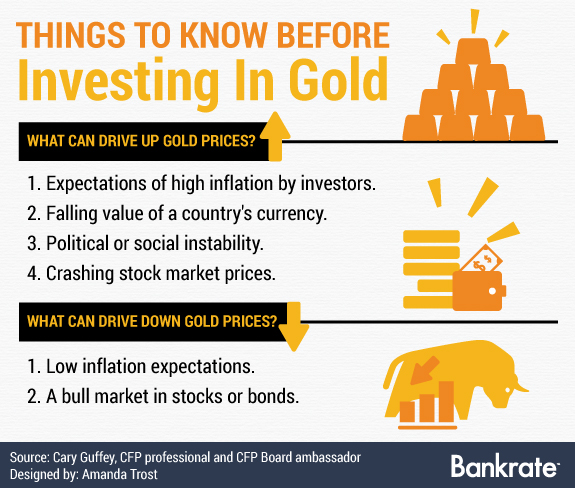
Just like anything else, the price of gold is influenced by the supply and demand dynamics. In fact, 5 years ago gold’s price was about S$1,800 per ounce compared to today’s S$1,664 per ounce. Alongside this dynamics are other factors that affect the gold’s price…

Sources: 1, 2, 3,  4, & 5

Read More...

You Wouldn’t Believe How Much Gold’s Price Has Fallen

Dan Gable once said: “Gold medals aren’t really made of gold. They’re made of sweat, determination, and a hard-to-find alloy called guts.”

In his own definition, gold’s essence translated to the person’s special characteristics. However, majority of the world perceives gold as a value commodity.

“What makes gold so valuable?”, you may ask. For starters, it lasts for a long period of time, it can be easily manipulated, and its appearance is very appealing.

But aside from this, gold is a rare element because no mine has an unlimited supply of it. Once all the gold is sold and spent, the mining company’s stock will fall. Any efforts to get more gold will affect the company’s wealth.

Gold’s rarity makes it more valuable than other common elements such as aluminum or iron. Its prices are not set by a single organization, rather they are influenced by the cost of production and the amount people are willing to pay for it. For instance, when the demand of gold is relatively high at a given base price and the competition is higher than expected, it is just right to increase the base price in order to regulate the demand of gold. And if not so many people are interested in purchasing gold, its price will stay closer to its actual production cost. Whether you like it or not, we are currently observing the latter statement about gold.

Gold’s price has dropped by about 1.4% last Thursday (14th April) – that is US$1,228.70 (S$1676.32) per ounce. This is in conjunction with the rising Asian shares and the strengthening of US dollar. Moreover, regional currencies weakened against the greenback after the country’s central bank set the rate of appreciation of the Singapore dollar policy band at 0%.

According to Gold Rate 24, a website that partakes information about the gold’s prices around the world, an ounce of 24K gold is priced at S$1,672.04 (US$1,226.99) while a gram of 24K gold is priced at S$53.76 (US$39.45) as of today. A substantial drop has been seen within 30 days from S$1,702.81/oz to S$1,672.04/oz.

HSBC analyst James Steel was quoted saying:

“Gold is weakening on a recovery in investor risk appetite. The sharp (equities) rally and the leveling off of gold-ETF demand recently argue for some period of price consolidation.”

Steel’s claim of the lowering investor risk appetite towards gold is supported by the figures of the world’s largest gold-backed exchange-traded fund – SPDR Gold Trust. Assets of SPDR Gold Trust fell 5.05 tones to 806.82 tones last Thursday, its lowest in a month.

The demand drop of gold affects the prices of other valuable elements such as silver, platinum, and palladium.

Sources: 1, 2,  3, 4 & 5

Read More...