Ask us questions, discover the latest offers & more on Telegram.
If you’ve ever hesitated to drive into Sentosa because of parking fees… this one’s for you.
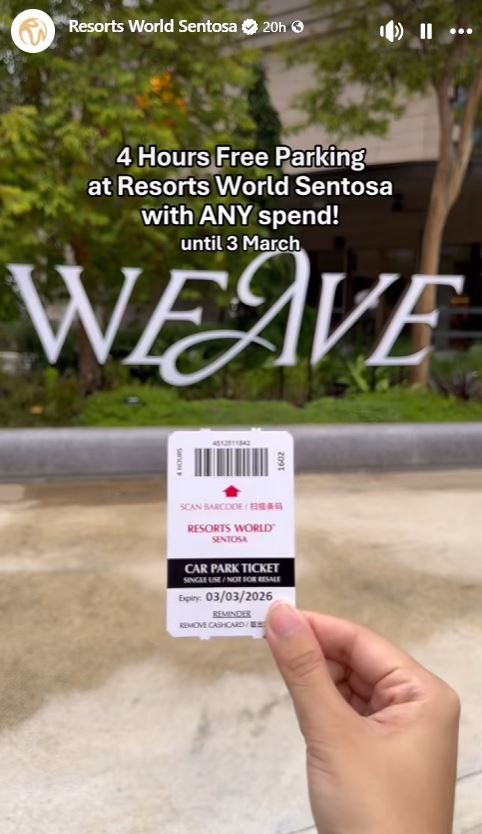
From 16 February to 3 March 2026, Resorts World Sentosa is giving guests 4 HOURS OF FREE PARKING with ANY spend at its retail or F&B outlets.
Yes, any spend — no minimum amount required.
That means you can pop by for brunch, coffee, snacks, a quick retail fix, or even just a casual meet-up — and enjoy up to four hours of complimentary parking at the RWS carpark.
How It Works
Make a purchase at any retail or food & beverage store within Resorts World Sentosa
Redeem your complimentary parking coupon on the same day of purchase
Head to the Redemption Booth at WEAVE, Level 1 (11am – 9.15pm, last redemption)
Present your original printed receipt for validation
Each coupon gives you free parking for the first 4 hours. After that, standard parking rates apply
Important Things to Note
Promotion runs 16 Feb – 3 Mar 2026 (inclusive)
Limited to 1 redemption per participant per day
Redemptions are first-come, first-served and subject to availability
Attraction tickets, hotel stays, casino levy, top-ups, vouchers and certain other receipts are not eligible
Pro tip: Remember to remove your CashCard from your IU/OBU before exiting to avoid extra charges
With four hours to spare, you’ve got plenty of time to explore dining spots, grab dessert, do some retail therapy, or simply stroll around without constantly checking the clock.
If you’ve been meaning to head down to RWS, this is a great little perk to make the trip even more worthwhile. Just don’t forget to redeem before 9.15pm — and keep that original receipt safe.
Sometimes, it’s the small savings that make the outing feel that much better.
If you’ve ever wondered whether certain outlets are “luckier” than others, you’re not alone.
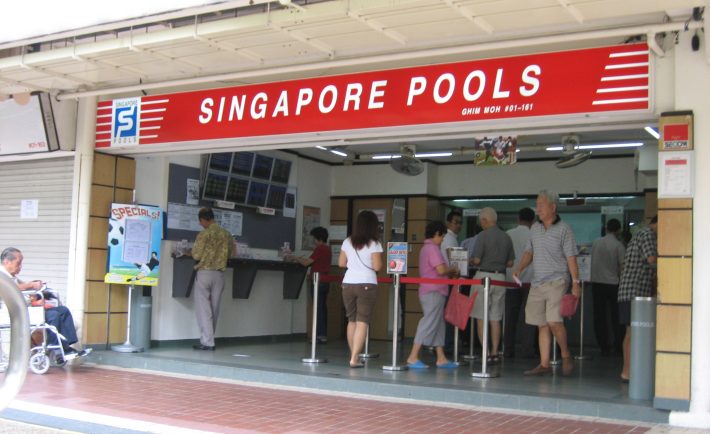
Singapore Pools publishes a running list of TOTO Winning Outlets — tracking where Group 1 (Jackpot) and Group 2 prizes were sold under the current 6/49 format (since October 2014).
While every ticket has the same mathematical odds, it’s always interesting to see which outlets have historically produced the most top-tier wins.
Based on the published Winning Outlets ranking, here are the Top 20 outlets with the highest number of Group 1 & Group 2 wins combined:
Singapore Pools – Top TOTO Winning Outlets
Group 1 & 2 prize frequency · Data from draws since 9 Oct 2014 (6-out-of-49 format)
#
Outlet
Group 1 Wins
Group 2 Wins
Total Wins
1.
Singapore Pools Account Betting Service ONLINE
219
1,225
1,444
2.
Delisia Agency Pte Ltd
24
100
124
3.
Tong Aik Huat
20
139
159
4.
NTUC FairPrice NEX
18
79
97
5.
Singapore Pools King George’s Ave Branch
16
40
56
6.
Fatt Chye Heng Trading
16
55
71
7.
Tan Wee Fong Trading
15
71
86
8.
NTUC FairPrice AMK Hub
15
57
72
9.
PFG Framing & Trading
14
53
67
10.
Ng Teo Guan Self Service
14
78
92
11.
Mee Lee Cheong Pte. Ltd.
14
53
67
12.
Laura’s Gifts
14
32
46
13.
Singapore Pools Suntec City Branch
13
38
51
14.
Singapore Pools Toa Payoh Lorong 1 Branch
12
49
61
15.
Singapore Pools People’s Park Centre (Chinatown) Branch
12
82
94
16.
Singapore Pools Hougang N1 Branch
12
44
56
17.
Singapore Pools Clementi N7 Branch
12
37
49
18.
NTUC FairPrice Tampines Mall
12
64
76
19.
Singapore Pools Yishun N1 Branch
11
56
67
20.
Singapore Pools Whampoa Drive Branch
11
51
62
Source: singaporepools.com.sg · Data from 9 Oct 2014 onwards (6-out-of-49 format)
So… Should You Buy From These Outlets?
That’s entirely up to you.
Some players enjoy buying from outlets with a strong winning history. Others just buy wherever is convenient. At the end of the day, TOTO is a game of chance — not geography.
Still, it’s always fun to know which locations have seen the most jackpot celebrations over the years.
Ask us questions, discover the latest offers & more on Telegram.
FairPrice Finest at Jewel is bringing something seriously exciting to snack aisles — and this one hits close to home for fans of iconic Asian flavours.
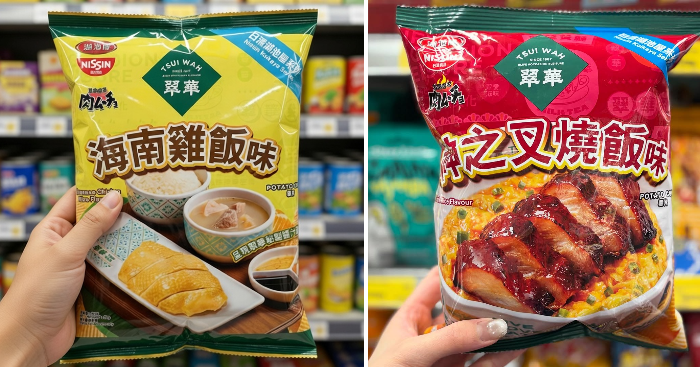
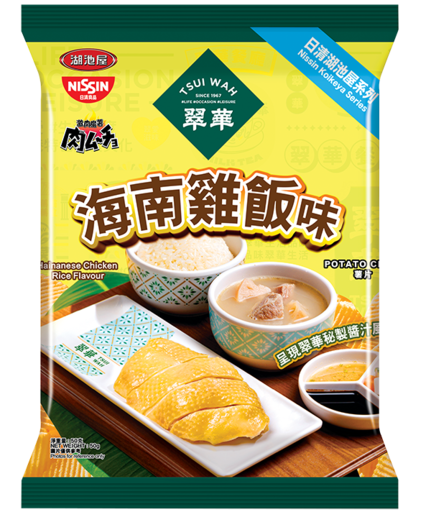
Two of Tsui Wah’s most beloved signature dishes have been transformed into crispy, flavour-packed potato chips, now available at FairPrice Finest Jewel.
From Restaurant Favourites to Snack-Time Cravings
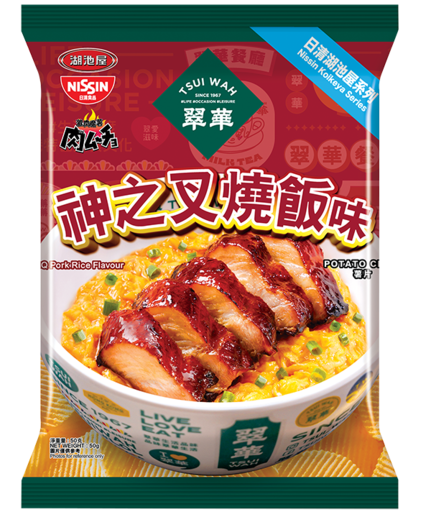
In a first-ever collaboration between Tsui Wah and Nissin Koikeya, the legendary “God of BBQ Pork Rice” (神之叉燒飯) and classic Hainanese Chicken Rice have been reimagined as crunchy potato chips
Yes — your favourite rice dishes… in chip form.
The BBQ Pork Rice Potato Chips capture the unmistakable aroma of Tsui Wah’s signature char siew, layered with smoky soy sauce notes and a hint of honeyed sweetness. Each bite delivers that caramelised, roasted flavour you’d expect from a proper plate of char siew rice — minus the queue.
Meanwhile, the Hainanese Chicken Rice Potato Chips bring together fragrant lemongrass, turmeric and Tsui Wah’s signature sauce blend, recreating the comforting, savoury depth of the classic dish. It’s nostalgic, aromatic and surprisingly addictive.
A Hong Kong Classic, Reinvented
Tsui Wah has long been known for elevating everyday comfort food into something iconic. Now, that same restaurant-quality flavour is being translated into a bold snacking experience — crispy, convenient, and dangerously easy to finish in one sitting.
Each pack is 50g, making it perfect for sharing… or not.
Available Now at FairPrice Finest Jewel
If you’re already heading to Jewel for a meal, a grocery run or just a stroll, swing by FairPrice Finest and keep an eye out for these limited-edition flavours. They’ve already launched in major supermarkets and with flavours this nostalgic, they won’t stay on shelves for long.
In Singapore’s fast-evolving economy, skills have become the primary currency of career growth. As industries adapt to digitalisation, automation, and global competition, employees are increasingly expected to update their capabilities throughout their working lives. Relying solely on past education or experience is no longer enough to remain competitive in the job market.
For working professionals, lifelong learning is no longer optional—it is essential. Employees who actively build new skills are better positioned to adapt to change, take on higher responsibilities, and future-proof their careers. Structured learning pathways play a critical role in supporting this continuous development, especially when they are aligned with industry needs and practical workplace outcomes.
Why Skills-Based Learning Matters More Than Ever
Singapore’s workforce strategy places strong emphasis on employability, productivity, and adaptability. Employers today value skills that can be applied immediately at work, rather than purely theoretical knowledge. As job roles evolve, employees are expected to develop both technical and transferable skills to stay relevant.
Skills-based learning helps employees:
Respond to changing job requirements
Improve performance and efficiency
Increase mobility across roles and industries
Build long-term career resilience
This shift has led many working adults to seek structured upskilling options that fit alongside full-time employment.
Core Skill Areas Employees Should Focus On
While the exact skills needed vary by industry, several broad skill areas are consistently valuable across Singapore’s workforce. These skills support both immediate job performance and long-term career growth.
1. Digital and Technology Skills
Digital literacy is no longer limited to IT roles. Employees across sectors are expected to understand digital tools, data systems, and technology-driven workflows.
Key digital skills include:
Data handling and basic analytics
Digital communication and collaboration tools
Understanding automated or technology-enabled processes
Cyber awareness and digital safety
These skills improve efficiency and help employees adapt to increasingly digital workplaces.
2. Technical and Job-Specific Competencies
For many industries in Singapore—such as engineering, manufacturing, logistics, healthcare, and built environment—technical expertise remains critical. Employees with strong technical foundations are often more productive and better prepared for advanced roles.
Job-specific skills may include:
Operating specialised equipment or systems
Applying technical standards and procedures
Troubleshooting and problem-solving in real work settings
Understanding industry regulations and safety practices
Structured learning helps employees formalise these competencies and apply them consistently.
3. Problem-Solving and Critical Thinking Skills
As work becomes more complex, employees are increasingly expected to think critically rather than follow fixed instructions. Problem-solving skills enable individuals to respond effectively to unexpected challenges and contribute to continuous improvement.
These skills include:
Analysing situations and identifying root causes
Evaluating options and making informed decisions
Applying logic and judgement in real-world scenarios
Adapting solutions based on outcomes
Strong problem-solving abilities are valued across all sectors and seniority levels.
4. Communication and Collaboration Skills
Technical skills alone are not enough for career growth. Employees must also communicate effectively and collaborate with diverse teams. In Singapore’s multicultural and team-oriented work environment, these skills are especially important.
Effective communication skills support:
Clear exchange of ideas and information
Better teamwork and coordination
Stronger relationships with colleagues and stakeholders
Improved leadership and supervisory potential
Courses that incorporate group work, presentations, and real-world scenarios help employees build these competencies naturally.
5. Adaptability and Learning Agility
Perhaps the most valuable skill in a changing job market is the ability to learn continuously. Employees who demonstrate adaptability are more likely to thrive during organisational changes, industry shifts, or economic uncertainty.
Learning agility involves:
Openness to new ideas and technologies
Willingness to update skills regularly
Ability to transfer knowledge across contexts
Confidence in navigating change
Structured lifelong learning helps employees develop this mindset and remain proactive about career growth.
Structured Learning Pathways for Skill Development
One challenge employees often face is identifying credible, structured ways to upgrade skills while working. Short workshops or informal learning can be useful, but they may not always provide comprehensive or recognised outcomes.
This is where SkillsFuture courses play an important role. These courses are designed to help working adults build practical, industry-relevant skills through structured training and recognised competency frameworks. Employees exploring structured upskilling options can consider SkillsFuture courses that focus on applied learning, professional competencies, and clear progression outcomes.
Balancing Work, Learning, and Career Progression
One of the strengths of structured upskilling pathways in Singapore is their focus on accessibility for working adults. Many programmes are designed to complement full-time employment, allowing learners to upgrade skills without taking extended career breaks.
This approach enables employees to:
Continue earning while learning
Apply new skills directly at work
Demonstrate immediate value to employers
Progress steadily without disrupting career momentum
For employers, this also results in a more capable and future-ready workforce.
The impact of skills-based learning is also visible beyond the workplace, particularly in hiring and job market outcomes. In Singapore, more than 2.3 million job applications have been submitted through skills-focused platforms, reflecting how recognised skills and structured learning can strengthen employability and improve shortlisting opportunities for working professionals.
Long-Term Career Benefits of Skills-Based Learning
Employees who invest in structured skill development often experience long-term benefits beyond immediate job performance. Over time, skills-based learning can support:
Career advancement and promotion opportunities
Greater job security and employability
Smoother transitions across roles or industries
Stronger professional confidence
In a competitive labour market like Singapore’s, these advantages can make a meaningful difference.
Conclusion
In today’s skills-driven economy, continuous learning is essential for sustained career growth. Employees who focus on building practical, relevant skills are better equipped to adapt to change and seize new opportunities.
Through structured and industry-aligned learning pathways, working professionals can develop valuable technical, digital, and transferable skills while remaining active in the workforce. For those committed to lifelong learning, investing in skill development is not just a career move—it is a long-term strategy for resilience and success.