Terms and Conditions:
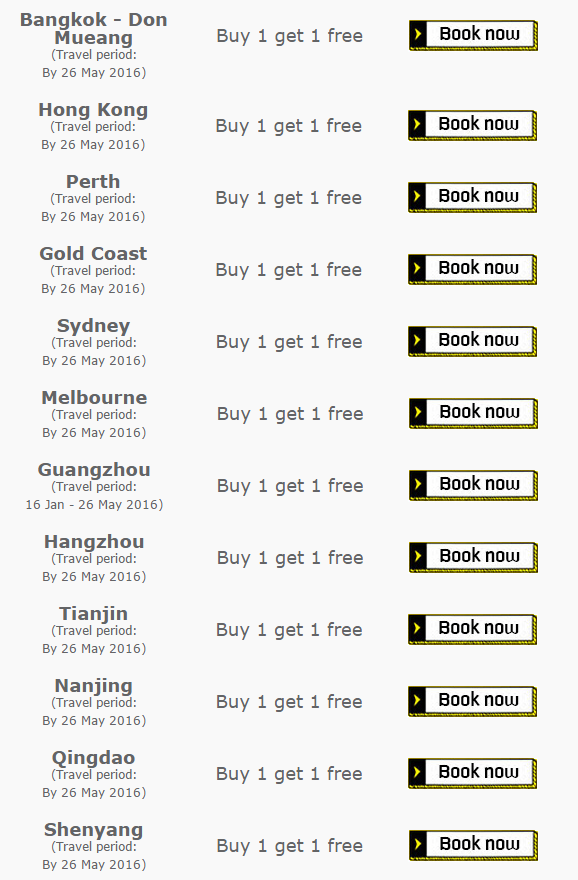
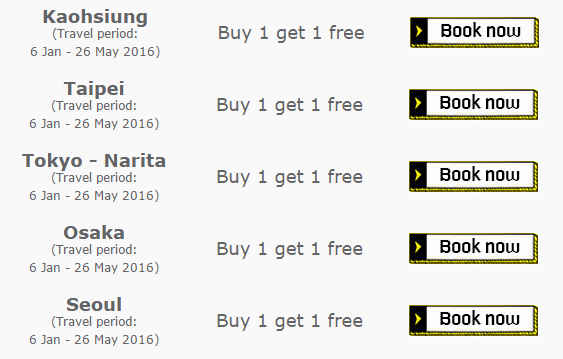
*Offer is valid for minimum of 2 adult passengers (not applicable to child) for Economy class bookings made at www.flyscoot.com/buy1get1 only. Taxes and surcharges apply, and are subject to change due to currency fluctuations. Economy fares exclude checked baggage, meals and inflight entertainment. Offer is valid for online bookings made at www.flyscoot.com/buy1get1, and is not available through Scoot’s mobile web and mobile app. Full payment is required at the point of booking. Payment processing fees per guest segment are not included. Full list of fees are available at www.flyscoot.com. Offer is subject to availability and confirmation. Seats are limited and may not be available on all flights or all dates. Bookings are not refundable except as provided in the Conditions of Carriage. All the terms and conditions are available at www.flyscoot.com
Need a hotel? Use our hotel search engine to suss out the best hotel deals from thousands of travel sites.
While many parts of the world are enjoying declining petrol cost, Singapore faces an inverse trend. The copious number of traffic lights and low speed limits are no stranger to Singaporeans; they work together to stretch the energy bill further. But overcoming these loathsome road characteristics is not exactly an Herculean task. Essentially, it just requires some minor tweaks to your driving behavior and the car.
Tires inflated to the proper pressure can improve petrol mileage by up to 3.3%. Such information on the proper tire pressure can be found in the car’s instruction manual.
Ensuring that the car has a properly tuned engine or has passed an emissions test can improve petrol mileage by an average of 4%, while addressing a severe maintenance issue can improve it by as much as 40%! Therefore, sending the car for regular inspections is a good practice!
Use the manufacturer’s recommended grade of motor oil which can improve petrol mileage by 1-2%. Besides, purchase motor oil with the “Energy Conserving”label to ensure it contains chemicals that reduce friction.
Stay above 48km/h as much as possible because the car consumes greater energy to combat wind resistance than rolling resistance at a lower speed. Carrying more loads and rolling down the windows can yield greater resistance at higher speeds, effectively cutting 1% to 15% of the fuel economy.
Time your acceleration adequately where you neither strain your motor nor trap your car in lower gears for too long which erodes fuel economy. A good estimate would be to accelerate to 80km/h within 15-20 seconds. Thereafter, keep a constant speed to prevent energy wastage on frequent deceleration and re-acceleration. Use cruise control function if available.
Brake less since braking converts useful kinetic energy into useless heat energy. Choose the route that has the least traffic – use the much vaunted Google Maps to plan the best route – to reduce unnecessary fuel wastage.
There is simply no need to warm up modern cars that are produced after the mid-1990s. Advanced engineering feat has made warming up irrelevant since sensors are now built into such cars to ensure the right mix of air and fuel in the engine – instead of relying on a warmed up engine to do the job uneconomically.
Visit Starbucks from 23 – 26 Nov 2015 and enjoy 1-for-1 desserts of the day.
Treat yourself to one of these four sweet treats and enjoy another to share.
Nov 23: Indulge in the creamy sweetness of the Raspberry White Chocolate Brulee Cheesecake. Sink your teeth into the luxurious white chocolate brulee cheesecake, complemented perfectly with tangy and juicy raspberries.
Nov 24: Enjoy a taste of zesty lemon in a slice of Lemon Curd Cake, a refreshing teatime treat decked with layers of fluffy sponge cake and sprightly lemon curd.
Nov 25: Next up is a childhood favorite. Dig into the luscious Cookie Crumble Cheesecake that is made up of wonderfully smooth cream cheese packed with generous cookie chunks.
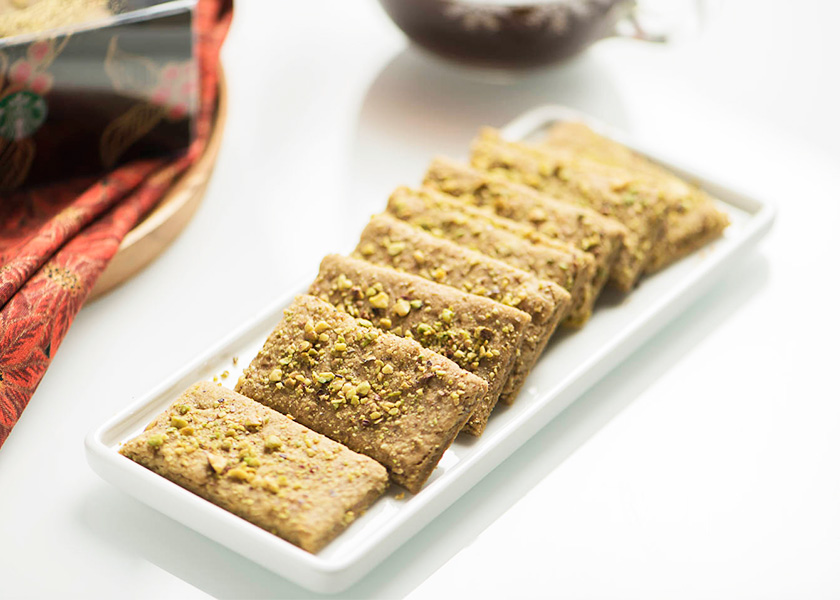
Nov 26: Sweeten someone’s day with a box of Pistachio Cookies. Munch on buttery cookies with nutty pistachio bits sprinkled throughout; this sweet treat makes the perfect snack or a gift for a friend.
Who would you share these sweet treats from Starbucks with? Share this limited time offer with your friends and family members to find out!
Recently, it has been reported by Singapore’s mainstream media that the cost to send a child to an international school in Singapore could reach up to a jarring amount of $500,000. Most Singaporeans would probably wind up in disbelief since we have been accustomed to the affordable public school fees that are the result of generous government subsidies.
From the economic perspective, critics are quick to dismiss this exorbitant option as some believe that the cost of receiving such an education would far outstrip the financial benefits that are fraught with a great deal of uncertainties. Indeed, there may be some truth to it. However, this premise may be limited in scope at the same time since it has not considered the intangible benefits – realised in the intermediate or long term – that overshadow the financial outlay.
The economics of social networks
Unequivocally, the quintessence of studying in an international school is the development of invaluable and diverse social networks. This is an instrumental consideration for both the child and their parents where the former solidifies their friendships with like-minded peers who come from similar socio-economic backgrounds, thereafter lending support to the latter’s efforts in expanding or diversifying their business networks.
Nonetheless, the maxim “birds of a feather flock together” does not only apply to this context. The different tiers of public schools inherent in the MOE school system also serve the same function. However, the demographics of the student populations may differ significantly as international schools tend to include more diverse nationalities and ethnicities and are more likely to attract the high income groups.
The teachers
International schools tend to recruit teachers from different parts of the world, which could serve as a great eye-opener for the young and malleable minds. The diversified talent pool of teachers share their individual overseas living experience and introduce different cultures and multifaceted ways of thinking and communicating to the students, all of which are life skills that cannot be emphasised more. By doing so, they also bring seemingly irrelevant subjects such as history alive and abstract theories students commonly read in the textbooks applicable to life.
Sublime teachers are a great source of inspiration, motivation and discipline, attributes that are possessed by most – if not all – successful people. While they may not be omniscient, the fact that they aspire to impart the best education in terms of practical knowledge and the right mentality to their students is praiseworthy. They are relentless in enhancing their knowledge and forming vital networks to improve their teaching strategies and materials, in the hope of providing greater enlightenment to their students on the particular subject. And such intangible value cannot be easily measured by any dollar amount. Unsurprisingly, such teachers are few and far between.
The answer
Therefore, from the viewpoint of a discerning expatriate parent, it is likely that the parent (mainly through the feedback of the child) has found immense value in the social networks and the quality of the teachers that warrants the hefty educational investment.








 Who would you share these sweet treats from Starbucks with?