Enjoy further markdown off their apparels by up to 70% off from now till 3 Jan 2016. (was initially 50% off)
Citi Cardmembers and wt+ members enjoy additional 15% off final bill (min. 3 pcs)
Check out the ad below for more information:
Terms & Conditions
Valid at all G2000 stores except sale outlets. Not valid on belts, socks and consignment goods or in conjunction with wt+ member discount, other promotions, bank rewards vouchers, other vouchers/coupons and the purchase of gift cards, unless otherwise stated. Full payment must be charged in a single receipt to a Citibank Credit or Debit Card unless otherwise stated. Citibank full disclaimers, terms and conditions apply to individual product and banking services.
While banking and finance professionals are still struggling with a decline in demand, Singapore and the Philippines are likely to see some pick-up in 2016.
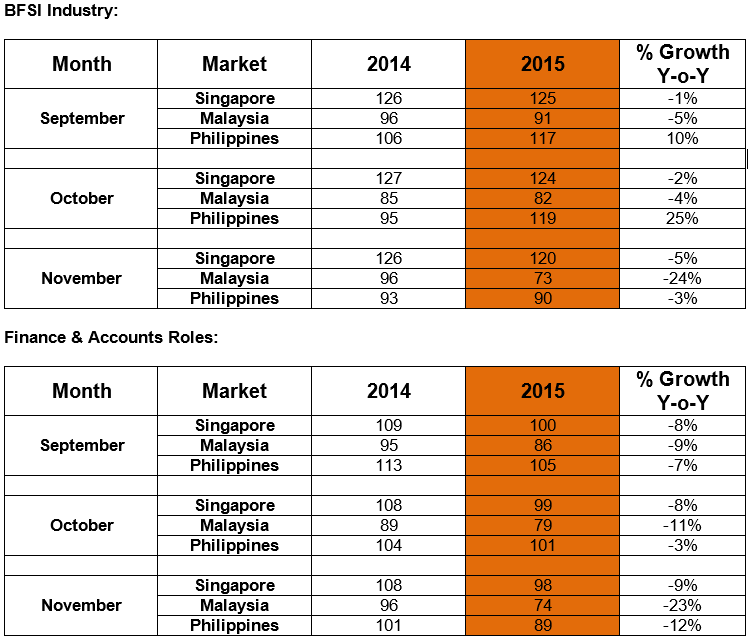
22nd DECEMBER 2015 – According to the latest Monster Employment Index (MEI), Singapore, Malaysia and Philippines experienced a drop in demand for banking professionals amid the volatile economic conditions in November.
Across the three markets surveyed by the Index, the Philippines reported the least year-over-year decline at -3%, down from October’s 25% year-over-year growth. This is the market’s first negative growth in three months and the steepest month-on-month decline registered among all markets.
The BFSI sector in Malaysia registered the steepest year-over-year decline at -24%, falling six times as much as October’s -4% decline. This is the sector’s third consecutive month of annual decline.
E-recruitment in Singapore’s BFSI sector experienced a slight drop between October and November, at -5% year-over-year. Despite this, the three-month growth rate for November has improved marginally by 3%, compared to 2% in October.
The MEI is a monthly gauge of online job hiring activity, which records the industries and occupations that show the highest and lowest growth in recruitment activity in Singapore, Malaysia and Philippines.
Recruitment trends in the BFSI sectors have also led to the sluggish demands for Finance professionals in the three markets. Despite the overall negative growth, Finance and Account roles are the top growth occupational groups in Malaysia and Philippines.
Malaysia reported the steepest decline between November 2014 and November 2015 at -23% year-over-year, a sharp year-over-year decline from October’s -11%.
Singapore witnessed the least year-over-year decline at -9%. This is a marginal drop from October’s -8% year-over-year. The Philippines reported a -12% year-over-year decline, down from the -3% year-over-year reported in October.
“As the global economy leans towards greater uncertainty, each market will need to take measures to build greater resilience against any vulnerabilities that can potentially deteriorate the country’s economy and affect recruitment,” said Sanjay Modi, Managing Director, Monster.com (India, Middle East, Southeast Asia, Hong Kong).
“While the demands for Finance professionals in the Singapore and Philippines markets appear to remain on the decline, Singapore’s vigilance to any potential economic risks and the Philippines’ strong economic fundamentals in its domestic systems should help see them through external threats.”
The Monster Employment Index is a monthly gauge of online job posting activity, based on a real-time review of millions of employer job opportunities culled from a large representative selection of career websites and online job listings. The Index does not reflect the trend of any one advertiser or source, but is an aggregate measure of the change in job listings across the industry.
See below for countrywide trends in Singapore, Malaysia and the Philippines for November 2015:
Singapore Highlights:
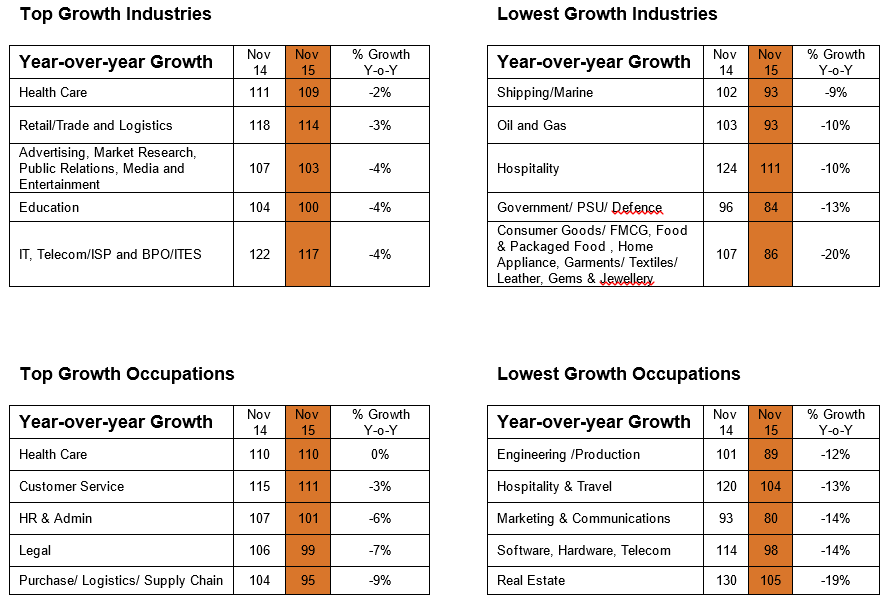
The Monster Employment Index Singapore declined -8% year-on-year.
No industry sectors or job roles registered positive year-over-year growth.
The Healthcare industry registered the least decline in online hiring at -2% year-on-year, while Healthcare jobs saw the highest demand – although at 0%.
Malaysia Highlights:
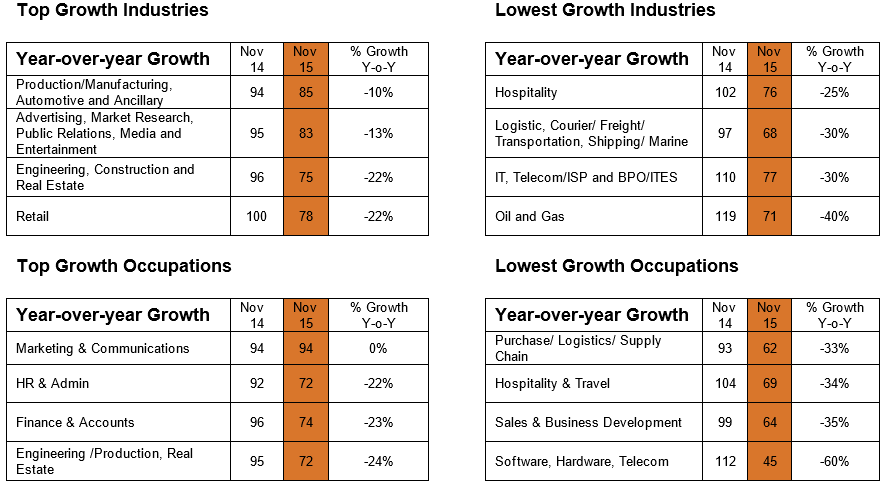
Online hiring in Malaysia declined by -31% year-on-year.
Not a single industry sector witnessed positive year-over-year growth in online hiring.
The Production/ Manufacturing, Automotive and Ancillary sector saw the least decline at -10%, while Oil and Gas registered the biggest drop at -40%
Demand for Marketing & Communications professionals takes lead at 0% year-over-year, while Software, Hardware, Telecom roles fared the worst at -60%.
Philippines Highlights:
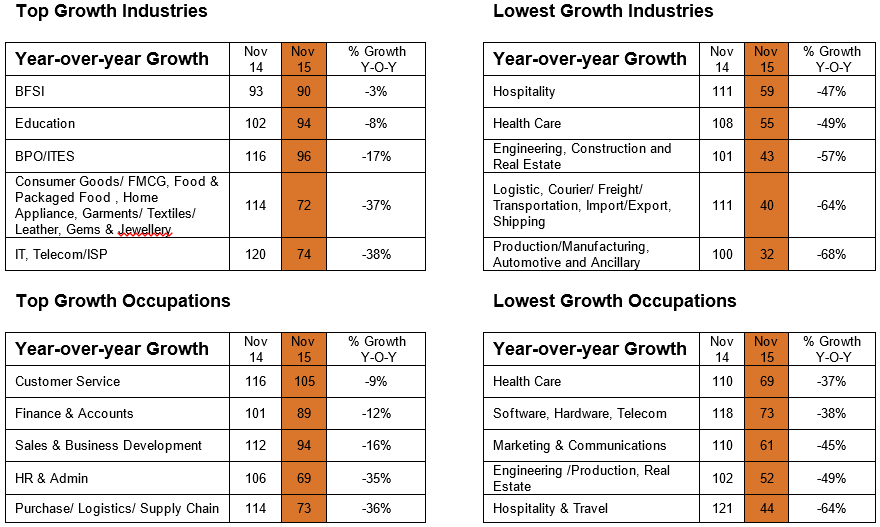
The Monster Employment Index Philippines registered a -46% year-on-year decline.
The BFSI industry had the least year-over-year decline at -3%, while the Production/Manufacturing, Automotive and Ancillary sector fared worst at -68%.
Customer Service jobs experienced the least decline at -9%, while Hospitality & Travel jobs reported the steepest decline at -64%
– Ends –
About the Monster Employment Index
The Monster Employment Index is a broad and comprehensive monthly analysis of online job posting activity in Singapore, Philippines and Malaysia conducted by Monster India. Based on a real-time review of millions of employer job opportunities culled from a large, representative selection of online career outlets, including Monster Singapore, Monster Philippines and Monster Malaysia, the Monster Employment Index presents a snapshot of employer online recruitment activity nationwide. Monster has taken due care in compiling and processing the data available from various sources for Monster Employment Index, but does not guarantee the accuracy, adequacy or completeness of any information and is not responsible for any errors or omissions or action / decision taken or for the results obtained from the use of such information. In the South East Asia region, Monster Employment Index was first launched in Singapore in May 2014 with data collected since January 2011 followed by Philippines and Malaysia in May 2015 with data collected since February 2014.
POPULAR Bookstore will be running a Moving Out Warehouse Sale this festive period.
That means you can look forward to a Book Buffet where you can pay $30 for a regular basket to fill 15 books or a large basket at $50 to fill 30 books. Choose any books you want that are on offer. In other words, you are essentially paying just $2 or $1.70 for a book. Can it get more affordable than that?
That’s not all. Stationery will be marked down by up to 70% and you will get a $5 voucher when you make a minimum spend of $30.
Sale will only last 4 days at their warehouse at 20 Old Toh Tuck Road.
Date: 24 – 27 Dec 2015
Time: 11am – 7pm
There will be a free shuttle bus from Jurong East MRT Station. Check the advertisement below for more information.
Grab all your friends along for this sale. Share this news with them on Facebook and see who’s up for it.
Frequent bank branch users in Singapore more likely to switch banks
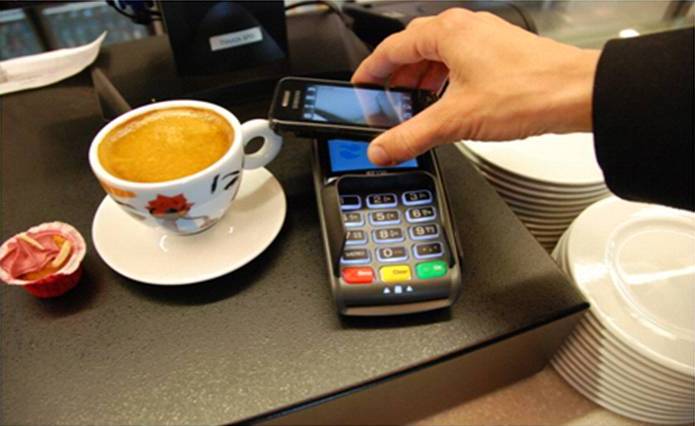
Singapore, 21 December 2015 – The writing is on the wall: consumers in Singapore view having to use bank branches for basic transactions as an inconvenience, which makes them more likely to turn away from their primary bank and flock to more on-demand ways to bank.
Bain & Company, in its sixth annual report on consumer banking behaviors, Mobilizing for Loyalty, asked which consumers would miss more for a day, their mobile phone or their physical wallet. The survey found mobile reigns supreme, with about 60 percent of the 2,500 Singaporean bank customers surveyed choosing their phone over their wallet. That share climbs to nearly 80 percent in China. Further, the survey revealed that those who rely on mobile and digital channels are 40 percent less likely to switch banks versus those who use mobile rarely. Conversely, those who frequently use a bank branch say they are three-times more likely to switch compared to those who rarely use branches. Yet, even as more banking activities go mobile, a major challenge for banks is identifying the right sequence of moves for delighting customers through a great mobile experience, while funding the investments in digital channels through cost reductions in the branch network.
Bain’s research reveals mobile interactions now exceed online interactions in 10 of the 17 countries surveyed, with the Netherlands and South Korea leading the pack and Singapore not far behind. Meanwhile, Japan and Germany lag well behind, due to the high adoption of ATMs and online banking, which provides less incentive for banks in these countries to invest heavily in trying to convert their customers to mobile.
Overall, banks’ investments in mobile are paying off in greater customer loyalty. Mobile apps used for routine transactions are one-third more likely to delight customers as similar transactions in the branch, whereas a routine branch visit is 2.4 times more likely to annoy – a pattern that repeats across many counties, including the U.S., the Netherlands and South Korea.
“As an example, our experience in the U.S. is that 60-70 percent of branch interactions in a typical bank are bad or avoidable,” said Gerard du Toit, lead author of the research and a Bain partner. “So, most of the time a branch visit results in an inferior customer experience and comes at a higher cost for the bank. Clearly, the branch as currently configured is headed for extinction.”
As such, some banks have been trying to shift routine transactions, such as deposits and cash withdrawals, away from their branches and into digital self-service channels instead, but progress is varied. For example, Mexico has more than six times the number of routine transactions per respondent compared to the Netherlands.
For the average bank, the most critical first step is to focus on improving the mobile experience – make it fast, intuitive, convenient and capable of handling basic needs to delight the customer. In many cases, this means forgoing the website for the mobile app.
“Just because you build a mobile app doesn’t mean customers will come,” said Harshveer Singh, partner in Bain’s Financial Services Practice in Southeast Asia. “Banks need to take deliberate actions to inform customers about the app’s benefits and encourage adoption at every opportunity.”
Next, banks must improve on their product sales capabilities:
More than 60 percent of buyers in Singapore used both digital and traditional channels for their research and purchase.
In Singapore, nearly 14 percent do their product research through mobile, and 14 percent actually buy through mobile.
“To make the product research and purchase experience shine on a mobile device, the products themselves must be reworked to make them easier to understand. The internal processes must also be overhauled to simplify the chain of activities,” said du Toit. “This is essential to stemming the ‘hidden defection’ issue we detailed in last year’s report – more than one-third of existing customers bought a product from a competing bank during the year.”
To succeed in banking, Bain identifies six new capabilities that bank organizations must have:
Extraordinary design discipline, given the small screen, slow speed of accurate typing and impatient users
Radical simplification of products, processes and communications
Personalization powered by good data and analytics so that only relevant information is displayed to the user
Contact methods that allow for anytime, anywhere chat and video calls with fast authentication
Much faster development cycles to keep pace with new functionality and consumer expectations
A new operating model that provides organizational agility, based on breaking down barriers that divide internal departments and a willingness to collaborate externally To receive a copy of the report or arrange an interview with Mr. Singh contact: Susan Renshaw at [email protected] or +65-6228-1094
About Bain & Company
Bain & Company is the management consulting firm that the world’s business leaders come to when they want results. Bain advises clients on strategy, operations, technology, organization, private equity and mergers and acquisition, developing practical insights that clients act on and transferring skills that make change stick. The firm aligns its incentives with clients by linking its fees to their results. Bain clients have outperformed the stock market 4 to 1. Founded in 1973, Bain has 53 offices in 34 countries, and its deep expertise and client roster cross every industry and economic sector. For more information visit: www.bain.com. Follow us on Twitter @BainAlerts.